Showing posts with label bottle stacking. Show all posts

Tuesday, June 10, 2014

On the Farm- Stoneware Sherd!

What could be more exciting than receiving a text from the farmer telling me that he found the neck and handle section of a jug while planting sweet potatoes?! Above is the marred remains of said jug section, but boy, was I excited! Do you see what I see?
Unglazed interior of the jug

First, we'll get out of the way that it is stoneware. It is also salt-glazed. The interior is not glazed which generally tells me that it pre-dates 1850, since that is when it starts to become more common to see pots glazed on the interior.
Marbling in the broken section showing the possibility of rolled clay
The handle is particularly awesome for many reasons. One, is that the end of the handle where it broke has this beautiful marbled texture that almost looks like the wedge of clay was rolled before being attached to the bottle and pulled for a handle. Does that make sense? The potter took a hunk of clay, rolled it into a fat snake-shape, then attached it to the neck of the jug, and pulled the shape of the handle. I don't know that this is for sure how it happened, but it makes sense to me and visually seems to match my theory.
The handle is also quite thick, roughly 1 1/4- 1 1/2 inches across at the top, which makes me wonder how large the jug was that needed such a thick handle!
Can you spot the cobalt blob at the upper part of the handle?

Cobalt blob circled

Another reason is that it has a blob of cobalt on the upper part of the handle where it joins the vessel. This tells me that it is probably not English, as I don't know that I have seen an English jug with a blob of cobalt at the handle juncture.

And then we come to perhaps the most tantalizing part of this piece- the evidence of kiln furniture! Can you make out the subtle chance in surface color and texture to the right of the handle remain in the photo above?


That subtle change in surface color and texture tells me that it is a touch mark, most likely where a piece of kiln furniture touched the top of the handle. Not just any piece of kiln furniture, mind you, but a bar!
Combined with the very dry surface of the rim, the touch mark and dry rim tell me that a bar was used to stack this jug in the kiln when it was fired. Check out a blog post I did a few years ago on this topic to get an idea of what the kiln furniture looked like. I'm not coming to the conclusion that this piece was made in Fayetteville (per the linked blog post), but I don't recall seeing stacked jugs like this much in Virginia (off the top of my head, maybe in Alexandria), and am not sure about Tennessee. The neck doesn't match the pieces from Fayetteville, either, so we'll toss that thought until we (hopefully) find more pieces!

We had a great turn out for the Carolina Farm Stewardship Association's Triad Farm Tour last Saturday and Sunday. This coming Sunday is our own farm open house and pottery sale. Lots of new pots, seconds, and older pieces at deep discounts!

Saturday, January 25, 2014

A Lesson in Kiln Furniture

As a part of the exhibition I curated at the North Carolina Pottery Center (on display through March 2014) I included a section looking at kilns, kiln furniture, and how kilns were fired and stacked historically.
Layout for a cross-draft kiln, not using as much stacking because of the height of the arch on the kiln
For the cross-draft kiln display I showed how pots were placed on quartz or other kinds of floor coverings, and then generally not stacked (sometimes they are) but able to stand from tallest to shortest depending on the height of the arch on the kiln. So the pots end up standing next to one another rather than stacked on top of one another.
Chester Webster jugs
Two vessels attributed to Chester Webster of North Carolina in the 19th-century show how in a cross-draft kiln there is usually directional ash coverage on the pieces- meaning one side is coated with more ash than another because the side facing the firebox is more likely to be hit with ash and direct flame.
Beginning of the updraft/downdraft stack
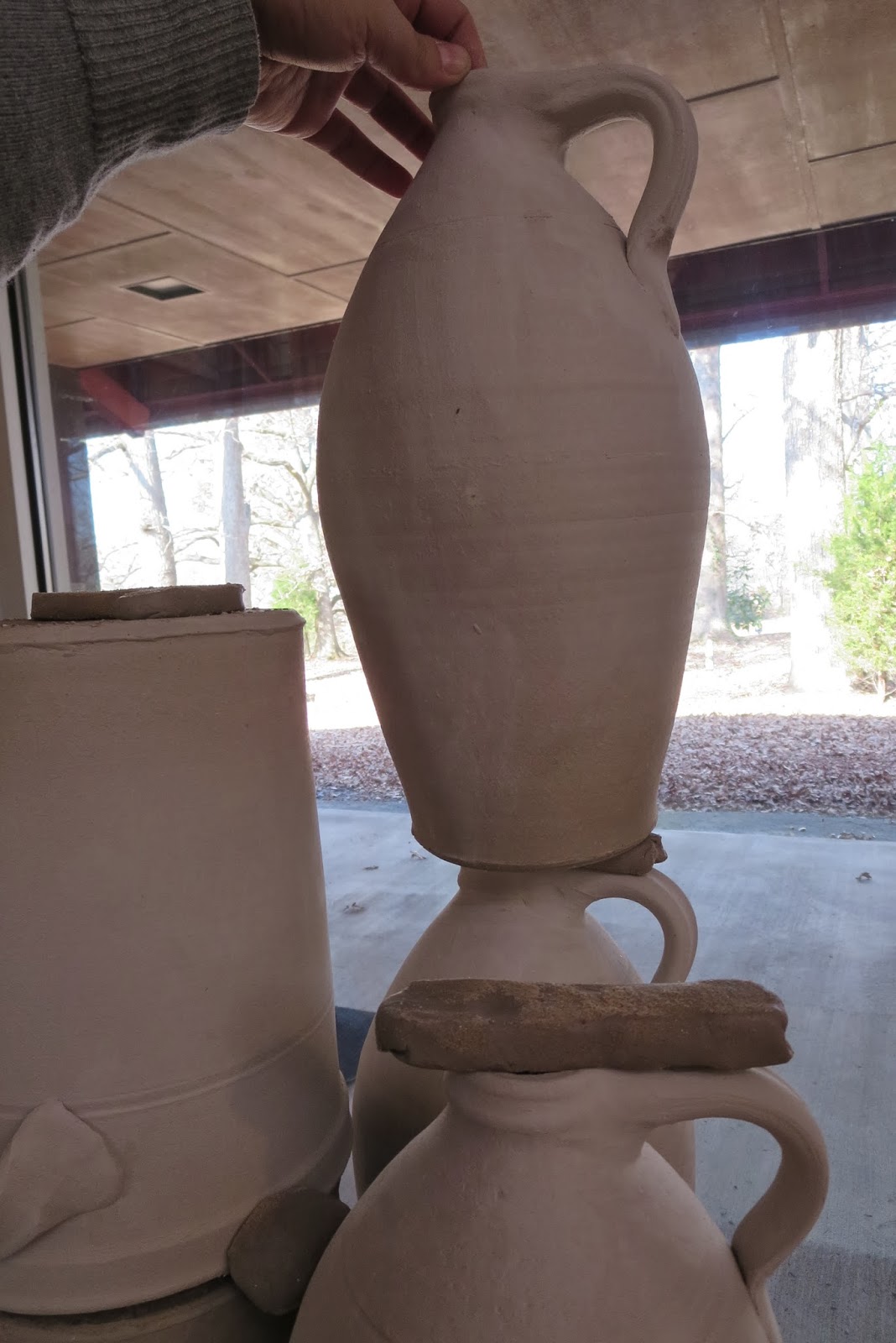
Then I went to work on the updraft or downdraft kiln style, stacking the pots on top of one another with kiln furniture. I made the pots a few days before I installed so they were moderately dry. The kiln furniture was fairly damp and I let the bars set up before installing them so they wouldn't warp or collapse. My initial thoughts on loading historic kilns were that the vessels were still green or damp when loaded, and they were placed in the kiln as they were made and able to be loaded. I've read a few things about this being done in cross-draft kilns, but don't have concrete evidence of it being done in an updraft or downdraft kiln. I am rethinking things, and here's why:

Making bars
Laying bars on the jugs
Once the bars were set up, or lightly dried, I placed them on the tops of the jugs, and underneath of the jugs and used them on the rims and base of the straight-sided crocks. This was based on pieces of pottery I saw with marks from the bars and archaeological collections where this type of stacking was used, such as the kiln site in Fayetteville, NC.


Placing spacers of different sizes

And spacers of different shapes
I placed spacers between the vessels to keep them from shifting onto one another. I sanded the ends of the pieces, and even put some glue on them since they will be there through March. I figured things were good to go- that the clay would all dry at about the same rate and that it would stay standing. Or, so I thought.
All stacked up!
At least it stayed standing. Here is what I found when I returned less than one week later:
Separated kiln furniture and one piece that kept falling off
Separated kiln furniture
The furniture was not holding up so well. It was falling off, shifted, and had completely separated from the vessels! I am glad I tried this before doing this in my own kiln, but now it is back to the drawing board for thinking out placement and installation of the spacers and other pieces. It makes me wonder whether the historic pieces also separated like this, and maybe fell down, but that the slight separation created during the drying was overcome by the shifting and movement of the pieces during the firing. I will keep you posted!

Tuesday, December 27, 2011

Collar or Jug Stacker?

Jug stacker or collar fused to the top of a jug. Courtesy, Alexandria Archaeology Museum.
I have a technical quandary I would like some input on. In working on my kiln furniture project, I have been struggling with whether to call the pieces placed on top of jugs for stacking in the kiln "collars" or "jug stackers."  My hesitation to use the term "collar" would be because the term “collaring” is used in referring to the pottery technique used to make the neck of a bottle. However, because of that too, I would option to use collar because the piece in question is placed on the jug where collaring begins at the shoulder of the jug. The collar goes on the collar of the jug.
And my hesitation to use the term “jug stacker,” as did Georgeanna Greer, is because it seems like a misleading term that does not fit its function. It does assist in the stacking of the jugs, but it by itself is not a "stacker" and is not stacked without being a part of another piece of pottery. Does that make sense, or am I looking too far into this?
Drawing made by Mike Heindl -- incomplete, not with all of the furniture! But just showing how the collars sat on top of the jugs and the jugs then stacked on one another.

This is the hole where the stacker/collar sits over the handle. This unfortunate piece was a bit overfired, or had too much weight on it, and it slumped making the collar/stacker stick to it. Courtesy, Alexandria Archaeology Museum.
For those of you still wondering what in the world I am talking about:
A jug stacker or collar was placed on the top of a jug in order to allow for an easier stacking method. Small bits of kiln furniture were placed on he bottom of the piece between the jug and the stacker/collar. I have also seen these pieces dipped in a white, sandy slip where the piece would come in contact with the pottery, assuming that the sand would keep the piece from sticking to the vessel. A hole was cut into the side in order to go over the handle. As opposed to saggars which are completely enclosed a jug stacker has a hole that goes above the bottle neck. Stackers/collars are also much shorter and smaller than saggars and tend to have angled sides or rounded edges (keeps the contact points to a minimal).
Collar/Jug Stacker from Rockbridge Baths Pottery Site, Virginia. Courtesy, Washington and Lee University Anthropology Department.
Do let me know whether you think it should be referred to as a "jug stacker" or a "collar"!

Wednesday, December 21, 2011

Bottle Stacking


Coutesy, The Museum of the Cape Fear, Fayetteville, NC
 It was a very exciting day researching a small collection at the Museum of the Cape Fear here in North Carolina. I got to see a stacking method for bottles that I have not seen such solid evidence for yet. For the most part, I have only seen evidence of using stackers, or larger saggar-like pieces for stacking bottles.
Let me see if I can make sense of what I saw today:

Meet Exhibit A:
Coutesy, The Museum of the Cape Fear, Fayetteville, NC
Meet Exhibit B:
Coutesy, The Museum of the Cape Fear, Fayetteville, NC
When A meets B:

Coutesy, The Museum of the Cape Fear, Fayetteville, NC
Look at the top of this handle piece, you can see the halo of a small circle:

Coutesy, The Museum of the Cape Fear, Fayetteville, NC
Here is my idea of how the bar was put on top of the bottle rim with a small pad on top of the handle to balance it out:

My sketch
Another bar in the collection may be evidence of how long the bars were.

Coutesy, The Museum of the Cape Fear, Fayetteville, NC
 I found the pinches at the center of the bar, as well as other bars, very interesting. I have yet to see other bars with pinches on the sides.
Coutesy, The Museum of the Cape Fear, Fayetteville, NC
Excellent find!