 |
| Crock, courtesy, Z&K Antiques |
Last year I started playing with Google images when I learned how to use an image to search through Google images by uploading an image with a few words, and the search engine then looks for photos with similar color, shape, and who knows what else. When I plugged in a few photos of some Kentucky stoneware, I came across
Z & K Antiques in Illinois. They have a lot of great antiques, particularly pottery, but one piece in particular caught my eye.
 |
| Crock, courtesy, Z&K Antiques |
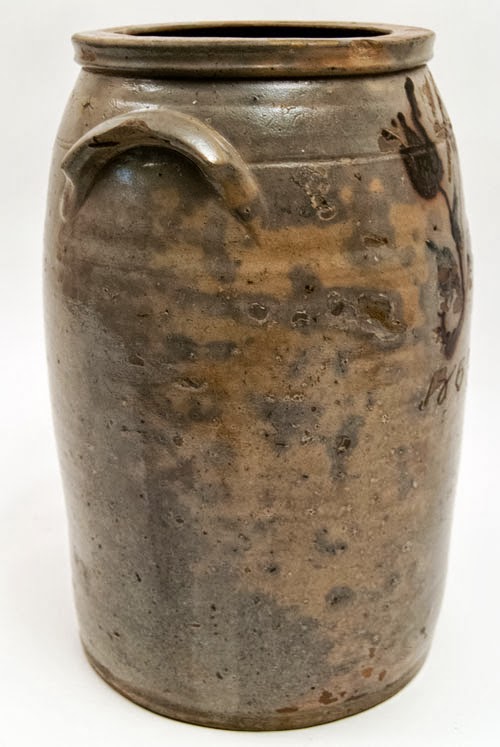
Z & K Antiques have a crock
highlighted on their website which is quite fascinating. I love most pottery (except maybe Sevres porcelain, sorry), but I particularly enjoy the pieces that speak to me as a potter and an historian. When I can see how the piece was made, decorated, or fired in very vivid details, it excites me to no end. Broken pots are sometimes the most exciting thing ever!
____________________________________________________________________________________
Just in case the piece sells, this is what Z&K had as the description of the crock:
Dated 1863: Note the stamped or
more formally done "5" gallon mark overwritten by a large 4. An
inscribed "4" was also added to the back of the crock so no mistake
would be made on its size. Highly unusual manganese floral decoration
and rare Civil War date make this an exceptional piece of antique
American stoneware. This unusual jar measures 12" Tall, 7" Wide at the
top, and 6 1/2" at the bottom.
Based on the red color of the crock's
clay, the manganese or mulberry of its decorated tulips, and its applied
handles (definitely Northern rather thab Southern in origin), we
believe this excellent slat glazed jar may have been thrown in
Huntingdon, Pennsylvania by noted American potter Henry Glazier, who is
well documented for using a mulberry slip to decorate his stoneware.
Glazier is known to have potted through 1854 before entering public
office, but he lived in Huntingdon throughout the Civil War and up until
his death in 1888. It is quite possible and even probable that Glazier
made some stoneware during the war when there was a shortage of men in
the work force due to the need for able bodied males to enlist in the
Union Army.
Regardless, howver, of who threw this jar
or where it was made, this jar stands as a metaphor of the duress of
the American Civil War. The potter simply chose to scratch a four over
his impressed five rather than erase the five or discard the piece
entirely and then chose to quickly add a date. The tulip decoration
itself is obviously quickly done, and the jar was not glazed very
thoroughly because there are many glaze skips. All of these things point
to the need to finish utilitarian products with a minimum of artistry
when our nation was at war with itself and our country's future hung in
the balance. This is a wonderful and rare piece of 19th century American
stoneware that embodies the turbulent times in which it was spun on the
wheel, glazed, and fired in the kiln.
_____________________________________________________________________________________
Who made the piece does not usually excite me either, unless it is from a particular kiln site or location I am studying (like Isaac Thomas or J&E Wood of Maysville, KY). The fact that it was made during the Civil War is quite cool, but I disagree with the description of the piece being representative of the duress of the War. Some of the components may have been hasty, but production pottery is pretty hasty, and with the lower number of potters working during that time, I think production was up, but quality was not down.
 |
| Crock, courtesy, Z&K Antiques |
The "4" scratched over the "5" was more likely the realization of a mistake when the vessel had too-far dried. I can't tell you how often I make this mistake- forget to stamp the bottom and then have to scratch my name in or forget to stamp the front and end up cracking the surface because it's too dry. I am empathetic to what seems like a flaw but it is endearing to me. I also am empathetic to the fact that the potter(s) coated the piece with a white slip over a darker body in order to try and get a gray surface. I have been doing this in my own kiln for a while now because my kiln is reducing a lot and the clay I have access to has a lot of iron in which turns dark during the firing. By putting the white slip over the surface, the iron clay body (usually) makes the white slip gray during the firing. I imagine potters had less choice of where their clay would come from during the Civil War because shipping things, say, clay from New Jersey, was probably really difficult.
 |
| Crock, courtesy, Z&K Antiques |
Check out the various photos of the piece though, and see how the white slip did not quite adhere to the entire piece. It sluffs off in some places, or crawls as we potters say, by peeling off or shifting during the firing. It's very possible this is connected to the scratched numbers and date. If the vessel was too dry when the slip was put on, it could have rejected some of the slip or dejected it while the slip was drying. Keep in mind that the majority of stoneware potters prior to the last quarter of the 19th-century were single-firing, so they did not bisque fire their pots and then glaze them.
 |
| Crock, courtesy, Z&K Antiques |
 |
| Crock, courtesy, Z&K Antiques |
Unfortunately, the piece does not really have great firing marks on the base or on the rim. I suspect by the way the salt is on the base though, that this piece was upside down during the kiln firing. The salt and wood ash combination have a particular pattern when they settle on a flat, level surface, as compared to what it would look like if it were the other way around.
|
| Crock, courtesy, Z&K Antiques |
Finally, the slips are really interesting too. I'm surprised the blue on the leaves of the plant and center of flowers did not become brighter in the firing when put over the white slip. Some of my blue slip turns darker with a reduction atmosphere, but it could also be because they were mixing it with the darker clay body slip. The iron rich, or possibly manganese slip, used for the stem and flower buds of the plant is not only really thick, but picked up the salt really well (which you can see where it looks like an orange peel in places).
Those are my initial observations of this great piece. Thanks Z & K Antiques for finding and offering such a treasure. If any of you all purchase this lovely item, I would love to meet it in person someday, so bring it with you when you come to visit!


