Sunday, January 19, 2014
Charisma vs. Personality in Art
Carter Gillies posted the other day with a blog entry entitled, "Personality and character reflected in art" in which he looks at the extroverted personalities of people and pots, as well as the culture of character that is often overshadowed by the larger personalities, be they the people who make the pots, or the pots themselves. I found the correlation between concepts usually applied to physical people and their personality vs. character and that of art and the work produced by potters quite fascinating. This folds into the conversations about branding that have opened the new year, such as Michael Kline, Tracey Broome, and Carter Gillies as well.
This is not to say that personality is a bad thing, but that perhaps we take personality over character too often. We emphasize personality over the good quality and character of our pottery and even our skills to catch attention or create more stir.
My initial response to Carter's entry was as follows:
"I agree that our pots have to have a certain balance of character and personality, and I think it’s hard to not rush toward the personality end when it seems like that’s the popular mark and you might get trampled if you stay in the character side. I think personality and character also relate to our world as artists in the way we market ourselves too. Particularly at shows, I think you have to have a certain balance of extrovert to be able to talk to customers, and yet a certain amount of character to be honest and engaged- a person with a lot of character always seems to be more engaging (when not like a door knob)."
Carter responded by saying, "It really is a balance we should strive for. And I’m glad you described this in extrovert/introvert terms as well. I do think the introvert aspect of making pots has a lot to do with the internal workings of our systems of value. Not exclusively, but it seems more readily found there. And I agree that the extrovert nature of doing public business definitely calls on aspects of personality in how we engage an audience, though as you point out a healthy dose of character can also be valuable. I hope that looking at our artistic practice in these terms helps shed light on the choices we make, and potentially gives us new options, or opens doors where we otherwise might not have recognized them."
This post of Carter's and our conversation stayed with me for several days, tumbling around. Then, the thought of personality vs. character became very real for me on Saturday when several people at the Market made recommendations for a new, flashy form I could make, or a way that I could add some quirky design or decoration to make my pottery stand out more, "speak" louder, and yes, one person said, "have more personality." I am given recommendations all of the time, and don't get me wrong, I enjoy knowing what people want to see or are interested in, but don't be offended if I don't take every recommendation into action (and this certainly does not mean that I am asking people to stop giving recommendations)!
I was listening to the TED radio hour this morning (which I highly recommend if you have never heard of this) and was captivated by the end of the program when Seth Godin was talking about the topic of whether ordinary people can be leaders. Similar to Carter's approach of moving something applied to a physical person to thinking about it in terms of objects or things people create, I listened to this part of the radio show with a split mind- listening to the speaker talk about the topic, and thinking about the topic as applied to pottery or art. Godin talked about a nonsense belief that leaders have to have charisma, which leads to leadership and he argued that "charisma doesn't cause you to become a leader, being a leader makes you charismatic."
So, taking this to the pottery side, ordinary, or seemingly ordinary pots without explosive personality, can be leaders on their own because of the strong character that they exhibit. Or perhaps the potters who may not be very forward with their work, but can make very strong forms, are able to become leaders by the example they put forward. I would safely say we have seen this often with some of the "big names" in the pottery world such as Burlon Craig here in the States and Michael Cardew in Britain, who were humble individuals, quiet to a certain degree, but hard-working, and persistent in their craft. Their work became emblematic to a following of people because of the skills they had and the strong pieces they made, not because of the forward personality they had.
Finally, Godin said, "If you want to be a leader, part of what you need to do is leverage the tools you've got, the people you have, and the momentum you have to do something...[that] takes you to a new place that is productive and useful." It is an investment of time, persistence, and visibility (to a certain degree) that makes a leader out of a person to a group of people, whether it is other potters, or those who admire our work.
Friday, January 17, 2014
Love What You Do?
![]() |
| The DWYL-inspired apartment of designer Jessica Walsh. Slate Magazine article. |
I got a little torn up this morning reading this article in Slate Magazine and wanted to see what your thoughts are. The title along, "Stop Saying 'Do What you Love, Love What you Do,' It Devalues Actual Work" was the first thing that set me off. "Actual work" or "real job" are pessimistic terms applied to the work people sometimes do to support their "other jobs" such as in the field of the arts, but perhaps all of the jobs they do are enjoyable in some manner or another?
This article is, in my opinion, not well written or researched (it reads like a well-intentioned class assignment that is all over the charts- can we say THESIS?), and biased. I'm going to leave out a rant on internships, because I don't think they should have tacked on something about it at the end after a long diatribe of too many other things. I'm also going to not go into the flustering smack in the face to people in academia who don't pursue high-paying careers such as law. However, I do want to share some of my thoughts related to other components of the article.
I agree with the component that people at the top of high-paying jobs say they enjoy their jobs and possibly overlook those lower down the chain of command who support their happiness. Exploitation is not cool, but here are a few things I took major issue with:
This passage-
"“Do what you love” disguises the fact that being able to choose a career primarily for personal reward is a privilege, a sign of socioeconomic class. Even if a self-employed graphic designer had parents who could pay for art school and co-sign a lease for a slick Brooklyn apartment, she can bestow DWYL as career advice upon those covetous of her success."
- implies that only elitist individuals, or those with a certain class status pursue work that they enjoy. As a potter and co-owner of a farm, I can tell you that we enjoy what we do, are not high class, and don't make a lot of money. The article also implies a racial division, which I also disagree with, particularly on the level of farming. We have met more people of more nationalities and color in the low-wage profession of farming. I have been told on numerous occasions to pursue what I love and find a way to do what I enjoy, and though the process has been frustrating at times, it certainly has its rewards. I grew up being told in various capacities that being an artist was not a way to make a living- that it didn't make money, that bums were artists, or that it wasn't "respectable." It took me over 20 years of pursuing various things to fall right back where I wanted to be - an artist and a potter. I may also be able to wax eloquently on the various intricacies of historic pottery or decorative arts, but that has become a part of my art and my career.
This passage-
"Yet arduous, low-wage work is what ever more Americans do and will be doing. According to the U.S. Bureau of Labor Statistics, the two fastest-growing occupations projected until 2020 are “personal care aide” and “home care aide,” with average salaries in 2010 of $19,640 per year and $20,560 per year, respectively. Elevating certain types of professions to something worthy of love necessarily denigrates the labor of those who do unglamorous work that keeps society functioning, especially the crucial work of caregivers."
- had me charged in a number of ways. How dare they imply that care giving, though sometimes of low wage, is not an enjoyable profession?! I have to wonder if the author ever stooped (and I say stooped because I think the author is biased and perhaps elitist themselves) to talking to a low-wage worker in many professions. Some may like the low-wage work on a different level with just being able to have weekends, perhaps be at home in the evenings, etc. We cannot assume that because someone does not have a high-paying job that they are lazy or unmotivated, or even that they do not like what they do to some degree. Someone told me the other day about a friend who took a long time to find what they really enjoyed doing. When they did find what they enjoyed, it turned out to be a garbage man. Why? Because they had the chance to find treasures that people threw out, and that was rewarding and enjoyable to them.
The final passage-
"Do what you love and you’ll never work a day in your life! Before succumbing to the intoxicating warmth of that promise, it’s critical to ask, “Who, exactly, benefits from making work feel like nonwork?” “Why should workers feel as if they aren’t working when they are?” In masking the very exploitative mechanisms of labor that it fuels, DWYL is, in fact, the most perfect ideological tool of capitalism. If we acknowledged all of our work as work, we could set appropriate limits for it, demanding fair compensation and humane schedules that allow for family and leisure time.
And if we did that, more of us could get around to doing what it is we really love"
- this whole paragraph is all over the place. Again, I agree that exploitation is not cool (that could have been a whole separate article on its own), but I don't know that making work feel like nonwork is the point. I know I am working by the strain of muscles, the lack of sleep, and the long days, but my work feels rewarding to me. If everyone enjoyed their work in the same capacity, or all enjoyed the same work, we'd be screwed out of jobs!
Perhaps I am reading into all of this a little far, but I think the author needs to redraft and spend some time looking over professions and the absurd emphasis that money is happiness, and only work that makes a lot of money could be rewarding.
What do you think?
Wednesday, January 15, 2014
On the Farm - A Girl's Best Friend
![]() |
| Our new chainsaw |
This is my mountain I am working on whittling down and preparing for the February kiln firing.
Work continues on the barn. All of the concrete footers have been poured and we are beginning on the piers. I've become quite skilled at running the concrete mixer and getting the consistency right!
Below, though, is perhaps one of the most exciting things at the farm today:
![]() |
| Bees heading back into their hive |
![]() |
| Close up of the bees heading back into their hive |
![]() |
| Enlarged image to show the pollen on their legs! |
Monday, January 13, 2014
52 Form Project - Week 2
![]() |
| Larger vase I made several years ago on the left with smaller, recent version on the right |
![]() |
| Courtesy, Digital Library for the Decorative Arts and Material Culture |
If you want a great video to watch, check out this video of Michelle Erickson making a reproduction of the Moravian ring bottle:
I also thoroughly enjoy five finger vases, or early ceramic vases with five openings that are fairly flat, such as this:
![]() |
| Courtesy, Chipstone |
The last one above particularly reminded me too much of this (which is not necessarily a bad thing, but not something I want to make):
By the end of the week, I threw everything out of the window (not literally) and went back to the drawing board. I took in mind my love of the ruffly edge on antique earthenware flowerpots, such as this Chester County, Pennsylvania piece from 1827:
![]() |
| Courtesy, Colonial Sense |
I think it will be a nice form to hold small buds of flowers or heads of larger flowers, such as my mock up with fake daisies:
Your input on this project would be greatly appreciated! I am hoping to gain some insight into what interest there may be for the forms I develop in the next 50 weeks and how I may make the forms different, or whether the forms are just too strange for selling!
Thursday, January 9, 2014
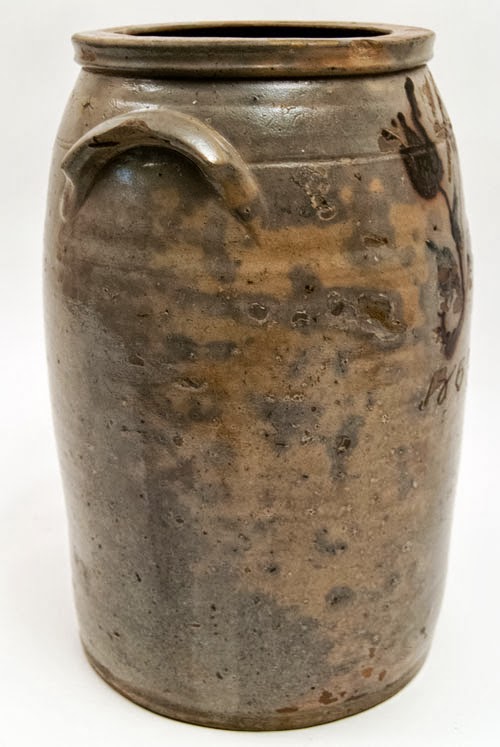
Dissecting an 1863 4-Gallon Crock
![]() |
| Crock, courtesy, Z&K Antiques |
Last year I started playing with Google images when I learned how to use an image to search through Google images by uploading an image with a few words, and the search engine then looks for photos with similar color, shape, and who knows what else. When I plugged in a few photos of some Kentucky stoneware, I came across Z & K Antiques in Illinois. They have a lot of great antiques, particularly pottery, but one piece in particular caught my eye.
![]() |
| Crock, courtesy, Z&K Antiques |
____________________________________________________________________________________
Just in case the piece sells, this is what Z&K had as the description of the crock:
Dated 1863: Note the stamped or
more formally done "5" gallon mark overwritten by a large 4. An
inscribed "4" was also added to the back of the crock so no mistake
would be made on its size. Highly unusual manganese floral decoration
and rare Civil War date make this an exceptional piece of antique
American stoneware. This unusual jar measures 12" Tall, 7" Wide at the
top, and 6 1/2" at the bottom.
Based on the red color of the crock's
clay, the manganese or mulberry of its decorated tulips, and its applied
handles (definitely Northern rather thab Southern in origin), we
believe this excellent slat glazed jar may have been thrown in
Huntingdon, Pennsylvania by noted American potter Henry Glazier, who is
well documented for using a mulberry slip to decorate his stoneware.
Glazier is known to have potted through 1854 before entering public
office, but he lived in Huntingdon throughout the Civil War and up until
his death in 1888. It is quite possible and even probable that Glazier
made some stoneware during the war when there was a shortage of men in
the work force due to the need for able bodied males to enlist in the
Union Army.
Regardless, howver, of who threw this jar
or where it was made, this jar stands as a metaphor of the duress of
the American Civil War. The potter simply chose to scratch a four over
his impressed five rather than erase the five or discard the piece
entirely and then chose to quickly add a date. The tulip decoration
itself is obviously quickly done, and the jar was not glazed very
thoroughly because there are many glaze skips. All of these things point
to the need to finish utilitarian products with a minimum of artistry
when our nation was at war with itself and our country's future hung in
the balance. This is a wonderful and rare piece of 19th century American
stoneware that embodies the turbulent times in which it was spun on the
wheel, glazed, and fired in the kiln.
_____________________________________________________________________________________
Who made the piece does not usually excite me either, unless it is from a particular kiln site or location I am studying (like Isaac Thomas or J&E Wood of Maysville, KY). The fact that it was made during the Civil War is quite cool, but I disagree with the description of the piece being representative of the duress of the War. Some of the components may have been hasty, but production pottery is pretty hasty, and with the lower number of potters working during that time, I think production was up, but quality was not down.
The "4" scratched over the "5" was more likely the realization of a mistake when the vessel had too-far dried. I can't tell you how often I make this mistake- forget to stamp the bottom and then have to scratch my name in or forget to stamp the front and end up cracking the surface because it's too dry. I am empathetic to what seems like a flaw but it is endearing to me. I also am empathetic to the fact that the potter(s) coated the piece with a white slip over a darker body in order to try and get a gray surface. I have been doing this in my own kiln for a while now because my kiln is reducing a lot and the clay I have access to has a lot of iron in which turns dark during the firing. By putting the white slip over the surface, the iron clay body (usually) makes the white slip gray during the firing. I imagine potters had less choice of where their clay would come from during the Civil War because shipping things, say, clay from New Jersey, was probably really difficult.
Check out the various photos of the piece though, and see how the white slip did not quite adhere to the entire piece. It sluffs off in some places, or crawls as we potters say, by peeling off or shifting during the firing. It's very possible this is connected to the scratched numbers and date. If the vessel was too dry when the slip was put on, it could have rejected some of the slip or dejected it while the slip was drying. Keep in mind that the majority of stoneware potters prior to the last quarter of the 19th-century were single-firing, so they did not bisque fire their pots and then glaze them.
_____________________________________________________________________________________
Who made the piece does not usually excite me either, unless it is from a particular kiln site or location I am studying (like Isaac Thomas or J&E Wood of Maysville, KY). The fact that it was made during the Civil War is quite cool, but I disagree with the description of the piece being representative of the duress of the War. Some of the components may have been hasty, but production pottery is pretty hasty, and with the lower number of potters working during that time, I think production was up, but quality was not down.
![]() |
| Crock, courtesy, Z&K Antiques |
The "4" scratched over the "5" was more likely the realization of a mistake when the vessel had too-far dried. I can't tell you how often I make this mistake- forget to stamp the bottom and then have to scratch my name in or forget to stamp the front and end up cracking the surface because it's too dry. I am empathetic to what seems like a flaw but it is endearing to me. I also am empathetic to the fact that the potter(s) coated the piece with a white slip over a darker body in order to try and get a gray surface. I have been doing this in my own kiln for a while now because my kiln is reducing a lot and the clay I have access to has a lot of iron in which turns dark during the firing. By putting the white slip over the surface, the iron clay body (usually) makes the white slip gray during the firing. I imagine potters had less choice of where their clay would come from during the Civil War because shipping things, say, clay from New Jersey, was probably really difficult.
![]() |
| Crock, courtesy, Z&K Antiques |
Check out the various photos of the piece though, and see how the white slip did not quite adhere to the entire piece. It sluffs off in some places, or crawls as we potters say, by peeling off or shifting during the firing. It's very possible this is connected to the scratched numbers and date. If the vessel was too dry when the slip was put on, it could have rejected some of the slip or dejected it while the slip was drying. Keep in mind that the majority of stoneware potters prior to the last quarter of the 19th-century were single-firing, so they did not bisque fire their pots and then glaze them.
![]() |
| Crock, courtesy, Z&K Antiques |
![]() |
| Crock, courtesy, Z&K Antiques |
Unfortunately, the piece does not really have great firing marks on the base or on the rim. I suspect by the way the salt is on the base though, that this piece was upside down during the kiln firing. The salt and wood ash combination have a particular pattern when they settle on a flat, level surface, as compared to what it would look like if it were the other way around.
![]() |
| Crock, courtesy, Z&K Antiques |
Finally, the slips are really interesting too. I'm surprised the blue on the leaves of the plant and center of flowers did not become brighter in the firing when put over the white slip. Some of my blue slip turns darker with a reduction atmosphere, but it could also be because they were mixing it with the darker clay body slip. The iron rich, or possibly manganese slip, used for the stem and flower buds of the plant is not only really thick, but picked up the salt really well (which you can see where it looks like an orange peel in places).
Those are my initial observations of this great piece. Thanks Z & K Antiques for finding and offering such a treasure. If any of you all purchase this lovely item, I would love to meet it in person someday, so bring it with you when you come to visit!
Monday, January 6, 2014
On the Farm - Preparing for the Cold
![]() |
| Row cover over the carrots and kohlrabi |
![]() |
| Carrots under the row covers |
![]() |
| More holes |
![]() |
| Turnips awaiting cleaning and processessing |
With the onslaught of winter veggies I made a large batch of cabbage soup with a few carrots, potatoes, and local sausage. I have an enormous amount of kale I intend to turn into kale salad (we don't use pine nuts, but rather crushed walnuts or sunflower seeds and I don't use the yogurt), kale chips, and perhaps some kale soup. We also made a big batch of chili for the colder weather, using up a few jars of our canned tomatoes from the summer. How I hate to see those jars dwindle! We also pulled some kohrabi which I intend to test out a batch of fermented kohlrabi with. Tasty experiments (usually)! Luckily, the turnips store well, I just have to get the greens off of them and trim them up a bit before putting them in the refrigerator. If you have someone who does not like the strong flavor of turnips (like my farmer), try peeling them and roasting them. The peel is where a majority of that sharp flavor is and the roasting makes them milder as well.
Thursday, January 2, 2014
52 Form Project - Week 1
![]() |
| Sneak peek from last week |
HAPPY NEW YEAR!
In celebration of a new year, I have embarked on a new project for each week of the coming years. I am calling it the 52 Form Project and will be making a new form each week. I am hoping this will, as Dan Finnegan once said, "stretch my legs" and stretch my creative brain for exploring new forms and variations on forms. I think this will be an opportunity to refine some techniques and put other techniques I have been wanting to play with to work.
For this first week I made lidded jars by throwing a closed vessel on the pottery wheel and pressing the side of the vessel to make the flange of the lidded jar. It's been a few years since I have played around with the technique of making a closed lidded form, so I brushed up on the technique with a few videos. First, I watched Jessy Johanneck in the following video:
Then I watched Melody Cooper's video for tips on trimming up the lid (I also enjoy how she puts her hair up!):
Here were the beginnings of my jars. Rather than cutting the vessels off of the bat, I left the piece attached to the bat and did not remove it until I cut it from the bat:
| Closed forms |
| Closed form with the knob |
I added white slip to the exterior and plan to paint patterns on the vessels with blue cobalt and some red iron oxide:
I tried a variety of shapes and did not find the straight-sided vessels to be as workable as this angled shape:
New project and more photos next week! Stay tuned!
Subscribe to:
Posts (Atom)