Showing posts with label Eastfield Village. Show all posts

Monday, January 5, 2015

Don Carpentier Tribute- the Half Saggars

Don showing the engine lathe in his pottery shop.
The world lost a giant in 2014 when Don Carpentier passed away. Don Carpentier was the mastermind behind Eastfield Village, and a maker of reproduction English mocha/dipped wares and shell-edge pottery. Eastfield was host to a series of workshops each year, focusing on various aspects of historic craft and architectural preservation. One of the workshops was focused on ceramics and pottery production, and was fondly nicknamed "Dish Camp." As a plug, the ceramics workshop as well as many of the other workshops are slated to take place this year. I will post more information when it becomes available.

Demonstrating kiln furniture and stacking at Eastfield in 2014.
I first attended the ceramics workshop in 2009, and first presented in 2011. Don was one of the few potters and skilled craftspeople that I have found such a strong connection with because of his interest in historic pottery, his experience in making reproductions, and his intense passion for learning. There are also few people I have met who get quite as excited about kiln furniture as I do. I think I was most heartbroken when Don passed because I lost such a kindred spirit and a mentor.
 Don had ALS for the last several years of his life and for the past two years that I saw him we communicated through various aspects other than speech. We once had a whole conversation in the dirt, drawing out ideas and wiping them away. In the summer of 2014 he had an Ipad that he typed things onto, but he still communicated on paper. I enjoyed our paper communications since we could banter back and forth through pictures, words, or just plain understanding what the other person was trying to say because we understood pottery on a similar level. Above is a photo of a conversation we had about half-saggars, excavated from a waster dump associated with the Bissett family of potters from New Jersey.
Photo of kiln furniture Don excavated in New Jersey. Courtesy, Don's Facebook page.

Photo of kiln furniture Don excavated in New Jersey. Courtesy, Don's Facebook page.
Don realized a few years ago through genealogical research that he descended from several prominent family of potters from New Jersey- the Bissett's and the Price's. Their exact history was obscured for so long because focus had been paid largely on the Morgan and Van Wickle potteries in New Jersey. However, Don being his lovely exploratory self, sought out more information about his family and began to break down some of the previous research on New Jersey stoneware. Above are a few photos of kiln furniture from a house site associated with the Bissett family near where the pottery operated. Don also wrote a great article on his research in the Maine Antique Digest in 2013, but the link is currently blocked unless you are a subscriber. If I get a direct link I will be sure to change it. You can read some notes on his research and collecting in a great tribute written by Brandt Zipp from Crocker Farm.


So, back to those half-saggars."Half-saggars?!" you might say? Don't worry, I said the same thing! They are purposefully-made, not fully round pieces in the same shape as a regular saggar. The edges are mostly clean-cut, and salted, so they were definitely used in the manner in which they were made.
Kiln furniture bar with piece of saggar attached.

Imprint of adjoining rim on base of kiln furniture.
Above is a piece of kiln furniture that had a piece of a saggar left on it as well as the imprint of an adjoining saggar rim.  Don came up to me while I was photographing the kiln furniture after most everyone left on Sunday. He saw me puzzling out the pieces and began placing them together so that I could wrap my brain around how they worked.
Placing a few half-saggars and kiln furniture together.


 I have never seen anything like this before or since, and am glad I took the time to measure the half saggars while I was there last summer. Saggars, as I have so frequently thought of them, are often fully round, and often enclosed (no holes or perforations) if not being used in a salt-glaze atmosphere.

Rough sketch of how the half-saggars and large bars may have interacted.
Saggars also tend to have a bottom of some kind, but instead, these saggars made use of thick, long bars that crossed the saggars to make a slotted floor.  It makes sense that this type of saggar would make use of more room and leave less empty space. Don wrote on our note I included above that they (the potters) were "desperate people," but perhaps they were just good engineers and figured something out that others had not. He also wrote "It must have been a site[sight] to see!" and truly, it probably was quite a sight when they had the kiln stacked up. As I was leaving "Dish Camp" last year, Don tapped me on the shoulder and guided me to a box of kiln furniture from the Bissett site and told me to take it home for my kiln furniture teaching collection.  I have a few small sections of these half-saggars in my collection now with the gift from Don, and hope that the other materials will stay together with his NJ pottery collection as a teaching tool. I wish I could have gone with him on his last expedition to excavate materials from near the pottery site in New Jersey.


Also, the week of "Dish Camp" was the beginning of when we started telling people I was pregnant. I will never forget the gleam of joy on Don's face when I told him. After giving him a hug before I left Eastfield, I told him to take care. He looked at me, smiling, pointed to my stomach, and mouthed, "you take care, too!"Thanks for all you did, Don, and for the short years I got to know you.

Wednesday, July 9, 2014

Traveling Potter Part II


My hope to have this posted mid-week last week clearly did not happen. Another part of my traveling adventure last weekend was to Don Carpentier's Eastfield Village in Upstate New York.


Each year, Eastfield Village hosts a series of lectures and workshops centered around various aspects of the structures and collections there. One such weekend is generally focused on ceramics of one kind or another, and is fondly called by many, "Dish Camp." It is a great experience that is unlike any conference. It's a laid back environment with presentations in an historic church. People bring archaeological material as well as intact pots to talk about various things or to get other opinions on what they have. The lectures are by people from various aspects of the ceramics world- collectors, scholars, researchers, archaeologists, enthusiasts- and it makes for a great weekend of learning and camaraderie.


I had the pleasure of presenting some of my newer research on Kentucky and Ohio River Valley pottery production There were some great speakers this year talking about a variety of things from archaeological adventures in Burslem, England to new aspects on Philadelphia-made earthenwares.


Rick Hamlin from Massachusetts came to talk with Dave Graci about Whately pottery, and he also demonstrated a few pottery making techniques.


 I did a pottery demonstration, but also demonstrated how kiln furniture functioned in the kiln as well as a demonstration of stacking pots with kiln furniture.


One thing I try to make sure to point out during a demonstration is how the thickness of the walls vary and also that the heft of an historic pot is not always because the potter could not throw well. It also had to do a lot with the clay and whether it had enough plasticity to have high walls, or absorbed water and slumped some at the bottom making for thicker foot profiles.
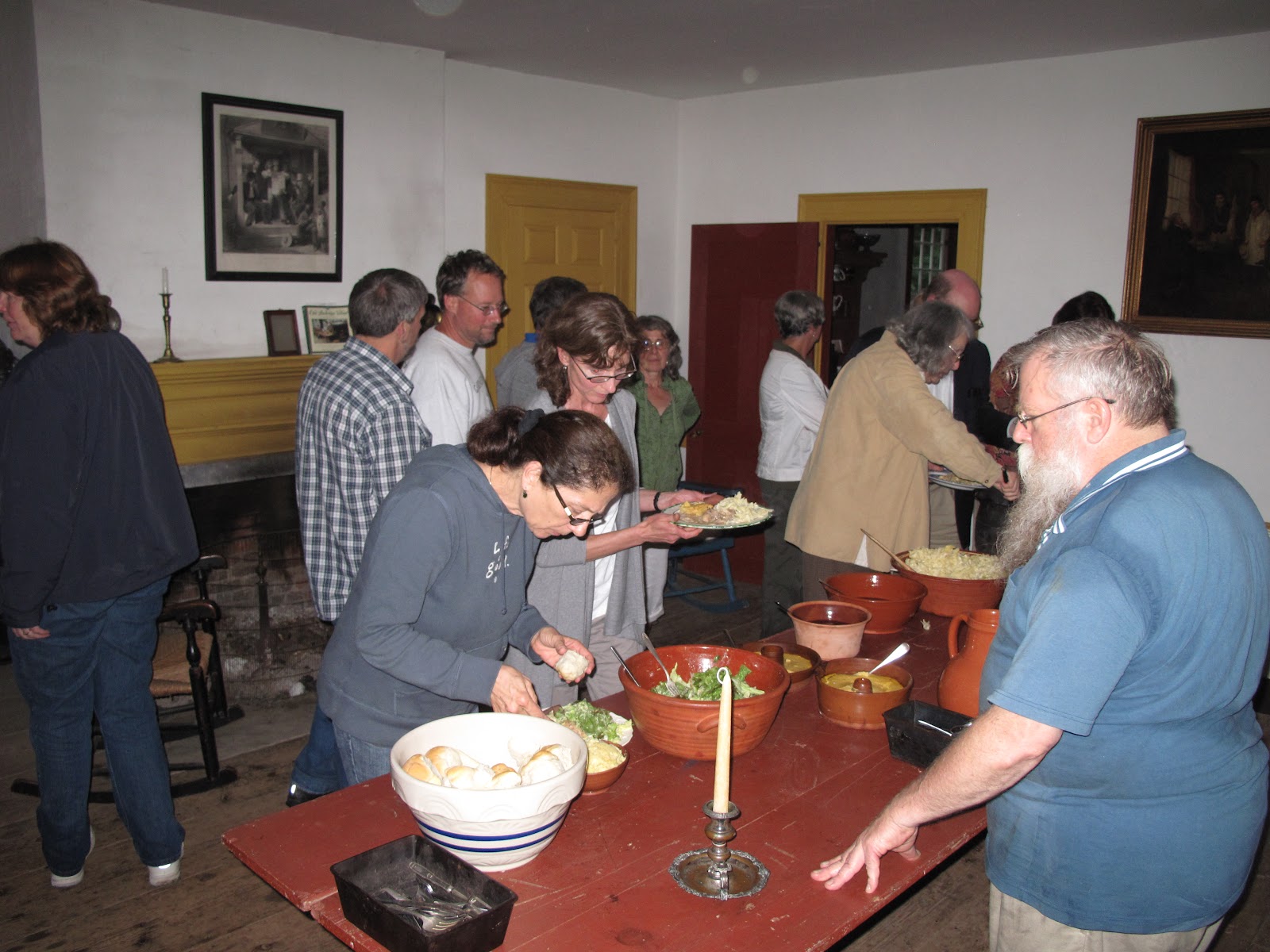
Each Saturday evening attendees are treated to a period meal cooked by kitchen demonstrators from Old Sturbridge Village. Dinner is served in the historic tavern on site, and often accompanied by music!

I tend to have shop envy when I visit Don's shop!

Don showing how the engine turning lathe operates
On Sunday Don showed everyone his shop and we watched several videos demonstrating his pursuit to learn how to build and operate a potter's lathe and an engine turning machine for making engine-turned creamwares as they did in England in the later 18th and early 19th-centuries. I thoroughly enjoy attending "Dish Camp" and highly recommend anyone interested in historic ceramics to go for a unique experience!

Monday, June 30, 2014

Traveling Potter Part I

I've been horrible to leave you all in the dark for the last month. Needless to say, there's been a lot going on and I will try to catch you up this week. For the past 5 days I have been in New England traveling first to Upstate New York for Don Carpentier's Eastfield Village ceramic workshop (which we fondly call "Dish Camp"). Last night I arrive in Deerfield, Massachusetts and had the opportunity today to work with the students in their Summer Fellowship Program. Slowly, I have been working to try and reach out to programs and conferences for doing workshops to talk about historic pottery, demonstrate pottery making, and particularly talk about kiln furniture and historic kilns. It is really fun to start to see things coming into fruition.
Talking about kiln furniture

I first did a presentation for the students about my background, my work in museums, and my hands-on experience and approach to material culture as a potter. Then we went into a workshop space where I talked about kiln furniture, showed various pieces from my collection, and talked about how to recognize how pots were fired by marks on their surface.
Stacking pots with kiln furniture


I then did a little demonstration with stacking pots in order to show the function of kiln furniture and how the various shapes interact with one another and the vessels.
After showing the students the basics of handles and throwing a vessel on the wheel, I got them on the wheel and making handles. Prior to coming, I made mug blanks in order for them to gain experience with pulling a handle from the side of the mug.

Particularly for students studying objects in museums, I think learning the various aspects of pottery production is important. Even understanding the basics can change your approach and understanding of an object.

 Above are their final products from the afternoon, a bowl-like form, and a handled mug! And for kicks, here is my face after my attempt to join two sections resulted in the base being too wet and collapsing:
More to come, stay tuned!

Monday, June 24, 2013

Dish Camp

It was a great weekend at Eastfield Village where I have been in the company of pottery enthusiasts, scholars, collectors, and professionals for the annual Eastfield Village workshop weekend focusing on pottery. Here are a few photos from Eastfield:
This is the chapel where we have all of the presentations

This is an original store from the early 1800s


I did a presentation which combined images from my days at Berea, to Winterthur, to my study of historic kilns, my kiln building, and then how I make, decorate, and fire my pots.  It was an excellent opportunity to reflect on my research on historic ceramics, kilns, etc., and how it has impacted my work as a potter.
At Eastfield we are provided with a hearth-cooked meal on Saturday evening, which is always a treat.

After the lovely supper I prepped some pots for the Sunday demonstration and was eaten alive by mosquitoes! When I asked Don Carpentier for a board of wood to put my pots on to set up, he brought me a piece of wood with a tongue, like for tongue and groove paneling or flooring. I said, "oh, what house did that come from?" to which he responded, "Just an 18th-century Dutch house." So there my pots awaited overnight, on their 18th-century Dutch board.


On Sunday I did a demonstration, talking about throwing techniques, contemporary and historical, and how to recognize various methods of pottery manufacture.  I just got back to North Carolina today and made a mad dash for Starworks to get some clay for the coming week's production. Last week or so of wet work before the kiln firing!

Here are a few more images of my demonstration:


Tuesday, June 28, 2011

Dish Camp

Things have been crazy! I am surprised I have had time to make any pottery! This past weekend I flew to New York where I attended and presented at Eastfield Village's Redware in America, 1650-1850 seminar. Each year, this is more fondly called "Dish Camp." I presented on the topic of my Master's thesis, the Moravian potters Pennsylvania. Johanna Brown from Old Salem Museum & Gardens presented on the Moravian potters of North Carolina, which made for a great dynamic and perspective on production.

People bring items and archaeological fragments for show and tell
People come from all over to attend and present at this workshop. There are different themes each year. There were quite a few archaeologists attending this year, which I thought was fantastic!

Between presentations there is a flurry of discussion and conversation over items brought in

Don Carpentier, who owns and runs Eastfield Village, is in the background
Greg Shooner, a potter from Ohio who reproduces lead-glazed (yes, real lead), often wood-fired pottery, came to present on the Shaker pottery of Union Village, Ohio, and do some demonstrations.

Greg Shooner demonstrated making slip-decorated, drape-molded dishes

This is his demonstration of applying slip-trailing on a wet ground
On Saturday evening everyone is provided a period meal cooked on the hearth and served by candlelight.

Flash photograph taken to show the delicious food!

Supper by candlelight
This year, Dr. David Barker from England (who presented on refined red earthenware bodies of England) brought his fiddle with him, I sang a few bawdy tunes and murder ballads, another attendee sang a German song, and we went up to the ballroom where we had a dance by the light of an 1830s Argand lamp!
Dr. David Barker playing the fiddle

Here are some photos of Eastfield Village:
The lane approaching Eastfield Village

This is a 19th-century church where the presentations are held!