Showing posts with label red earthenware. Show all posts

Tuesday, August 19, 2014

Earthenware Experiment- What Went in the Kiln


As I mentioned in one of my earlier sporadic blog posts, I have been playing with earthenware in the studio lately. It's been something in the back of my mind for years to try earthenware in a wood kiln. This is mostly because through my kiln furniture research I knew that many early stoneware potters were also making earthenware, but all in the same kiln. So, the biggest quandary I had was what would earthenware look like in a salt kiln environment?

After spending a day cleaning the kiln and shelves last week, the kiln got loaded up last Friday and the fires started on Sunday.

I used the marbled technique that I recently made a post about both on lids and on the sides of some mugs. All of the pots in the photos to come have been bisque-fired, so these are not the finished products.


I ended up having an issue with a white slip that I tested. It may have been a reaction to the clay I was using at the time of the slip tests (Highwater Lyman Red), but either way, I ditched it because I could not keep it from cracking and flaking. I did fired several bowls that had cracking just to see if the flux (3134 Frit) in the slip would heal with a glaze in the kiln. We shall see.

I switched to a very basic white slip and started using Highwater's Earthen Red clay, which I thoroughly enjoyed throwing with. I kid you not, it's like chocolate pudding between your fingers. The switch proved worthwhile and I had a smooth slip that dried well and played nicely even after the bisque firing.
I am testing several clear glaze recipes. One recipe uses mostly white clays as its base, so it turns a very white color after glazing. The other is basically 3134 Frit and Redart, making for a brown-looking glaze.


I played around a little bit with some manganese, by sifting some raw manganese on top of the glazed surface, and sponging it after mixing it with a white slip. The mugs above have lines of sponged manganese and green slip. I anticipate a deep purplish brown/black, but will wait to see what actually turns out.


Other decorated wares included a few squared bottles and some slip trailed and marbled dishes. I was really excited to see how those turned out in the bisque kiln, and am hopeful for their survival in the firing.

You might think I sound a little pessimistic about how this all might turn out. I'm not pessimistic as much as I am hesitant. There's not really a lot of people wood-firing earthenware here in the states and I think it has a lot to do with our restrictions on lead usage. Lead and lead variants like galena are very forgiving in their fluxing and melting temperatures. They don't craze a bunch, or have major reactions like pitting, flaking, or pin-holing. Those things are what I have heard can happen with earthenware in a wood kiln, particularly if it reduces. As one potters once told me, "it's hard to keep a wood kiln out of reduction" and my kiln has that very issue. We didn't seem to have a lot of reduction during the firing this go-around, but will not really know until we open it up.

So, fingers crossed, I teamed up with Anne Partna from Blue Hen Pottery and together we made enough pieces to fill the kiln. Here are some photos of the stacks in the kiln:


I did an overnight gas preheat, which I have found heats the kiln up to around 225 (F), dries out the interior, and starts to heat the brick up. Heating the brick up seems to be what takes the longest with this kiln because I used all hard brick. The more the brick is heated up, the faster the kiln will roll to the end. The firing proved to be a little lengthier than we were anticipating, but it was still not as grueling as a stoneware firing. We are unloading later this afternoon, so stay tuned!

Tuesday, March 6, 2012

Kilns Gone Wrong

Earthenware separating bars, Piercy Pottery site. Courtesy, Alexandria Archaeology Museum
There are archaeological sites where evidence of the production of stoneware and earthenware are found. Often these sites are called "transitional" with the implication that the potters were moving from working with earthenware to stoneware. However, my thoughts are that many of the potters, particularly in regions with less potters, or with higher levels of competition, met the market demands by making both either simultaneously or attempting to make both at some point in their production. For example, the William Rogers site in Yorktown, Virginia was making both stoneware and earthenware. There are certainly numerous sites where the potters did in fact move from earthenware to stoneware, such as the Thompson potters in Morgantown, West Virginia (on which topic I highly recommend an article on these potters in the 2011 Ceramics in America).
REALLY overfired bar used on the top of a jug -- the ring in the middle was the top of a jug! Piercy Pottery site. Courtesy, Alexandria Archaeology Museum

Closeup of the melted bar. Piercy Pottery site. Courtesy, Alexandria Archaeology Museum
The (nerdy) humorous thing is to see archaeological evidence that potters who may have been more familiar with one material (i.e. earthenware), may not have been familiar with the other (i.e. stoneware). Which explains why sometimes you read about potters being brought in for their expertise in one material or another. For example, when I was recently at the Alexandria Archaeology Museum, I saw a collection from the Piercy Pottery site. This was primarily an earthenware production site, but there was some evidence of stoneware production as well. I should say that there is speculation that because the amount of stoneware wasters are so low, the attempts at stoneware production were made in the late 18th-century when the site was rented by another potter who went on to make both earthenware and stoneware. Either way, the wasters revealed that at some point their stoneware attempts went horribly wrong! The stoneware separator bars they made are also some of the thickest bars I have seen yet, which is not surprising after seeing their earthenware separator bars (first photo at top). 
On left, bisque stoneware separator bar and fired salted separator bar on right. Piercy Pottery site. Courtesy, Alexandria Archaeology Museum
Their method of stacking the stoneware pottery seems more precarious, too. Typically, one wants to balance the weight of the pieces over another, placing rims, bases, and other points of weight on top of each other.
Bar adhered to base of jar, with indentation showing where the rim of another jar rested during firing. Piercy Pottery site. Courtesy, Alexandria Archaeology Museum

How the base of the jar rested above the rim of the other vessel-- off center! Piercy Pottery site. Courtesy, Alexandria Archaeology Museum
I said that this was humorous because I reflect on these pieces both as a potter and as a scholar. As a potter, I can only imagine the horror on the workers' faces when they opened the kiln and their experiment had gone horribly wrong (been there, done that!). I chuckle sometimes because I think there were a lot of "oh, poop!" moments historically, just like there are in contemporary potters' lives. And as a scholar, I reflect on the attempts of pottery production sites to challenge an import market, a growing population of potteries, and the changes in the uses of utilitarian vessels and forms.
For more information on the Piercy Pottery site, be sure to check out Barbara Magid and Bernard K. Means' article in the 2003 Ceramics in America. You can read the text here, but you miss the beautiful photos!

Tuesday, June 28, 2011

Dish Camp

Things have been crazy! I am surprised I have had time to make any pottery! This past weekend I flew to New York where I attended and presented at Eastfield Village's Redware in America, 1650-1850 seminar. Each year, this is more fondly called "Dish Camp." I presented on the topic of my Master's thesis, the Moravian potters Pennsylvania. Johanna Brown from Old Salem Museum & Gardens presented on the Moravian potters of North Carolina, which made for a great dynamic and perspective on production.

People bring items and archaeological fragments for show and tell
People come from all over to attend and present at this workshop. There are different themes each year. There were quite a few archaeologists attending this year, which I thought was fantastic!

Between presentations there is a flurry of discussion and conversation over items brought in

Don Carpentier, who owns and runs Eastfield Village, is in the background
Greg Shooner, a potter from Ohio who reproduces lead-glazed (yes, real lead), often wood-fired pottery, came to present on the Shaker pottery of Union Village, Ohio, and do some demonstrations.

Greg Shooner demonstrated making slip-decorated, drape-molded dishes

This is his demonstration of applying slip-trailing on a wet ground
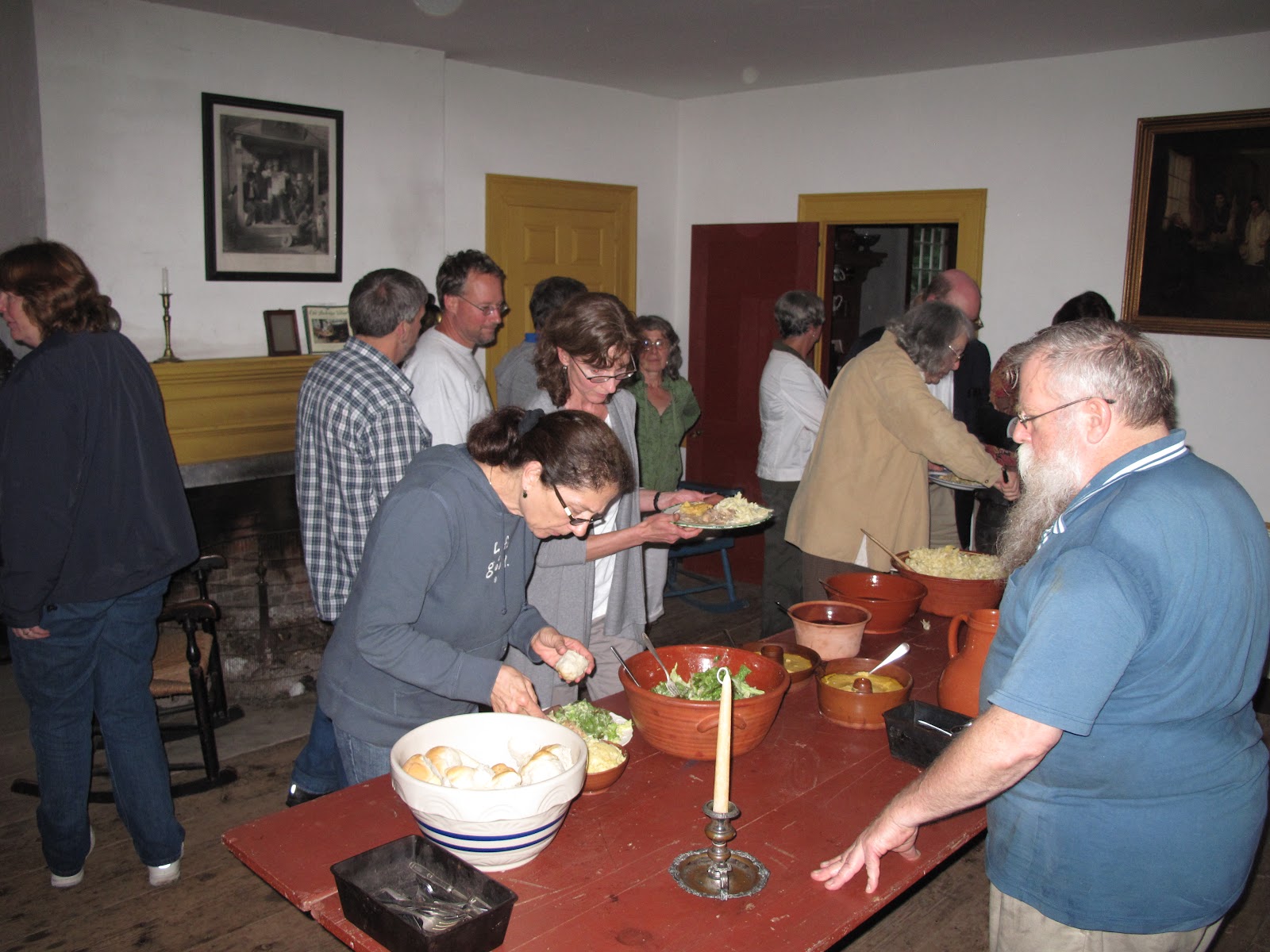
On Saturday evening everyone is provided a period meal cooked on the hearth and served by candlelight.

Flash photograph taken to show the delicious food!

Supper by candlelight
This year, Dr. David Barker from England (who presented on refined red earthenware bodies of England) brought his fiddle with him, I sang a few bawdy tunes and murder ballads, another attendee sang a German song, and we went up to the ballroom where we had a dance by the light of an 1830s Argand lamp!
Dr. David Barker playing the fiddle

Here are some photos of Eastfield Village:
The lane approaching Eastfield Village

This is a 19th-century church where the presentations are held!