Showing posts with label stoneware. Show all posts

Friday, May 16, 2014

Kiln Results Headed to Show!

I unloaded the kiln earlier this week between work at MESDA (Museum of Early Southern Decorative Arts). Tomorrow, I get to be on the grounds of Old Salem and a part of the Pottery Fair on the Square where I will have new pieces from the recent kiln firing!


This will include some exciting new hanging flower planters, as seen in the two photos above. They're all rigged up for hanging!

So come visit tomorrow between 10-5:00 on the square in Old Salem. Check out the farmer's market there, too, in the morning until noon. If you have time, don't miss the opportunity to see a hidden gem like MESDA.

Here are a few more photos of things in the kiln:

Wednesday, April 2, 2014

52 Form Project- Week 11


The 52 Form Project 

What is it?
My 52 Form Project is devised to help me stretch my creative muscles, explore new forms, or finally get to making forms I have been wanting to try for a long time. I am planning to make a new or modified form for every week of this year.
How can you help?
Your input on the forms, their shape, decoration, appeal, and function would be greatly appreciated. Some forms, if they seem like they may do well in the market, may become a part of my regular production.
Delayed Week 11
Week 11's form was a bit thrown together, literally and figuratively. It admittedly was not the focus of my week since I was absorbed in getting things finished for the kiln firing. Then I was absorbed in the cleaning, packing, and the show. So it goes.

Finished piece before the firing
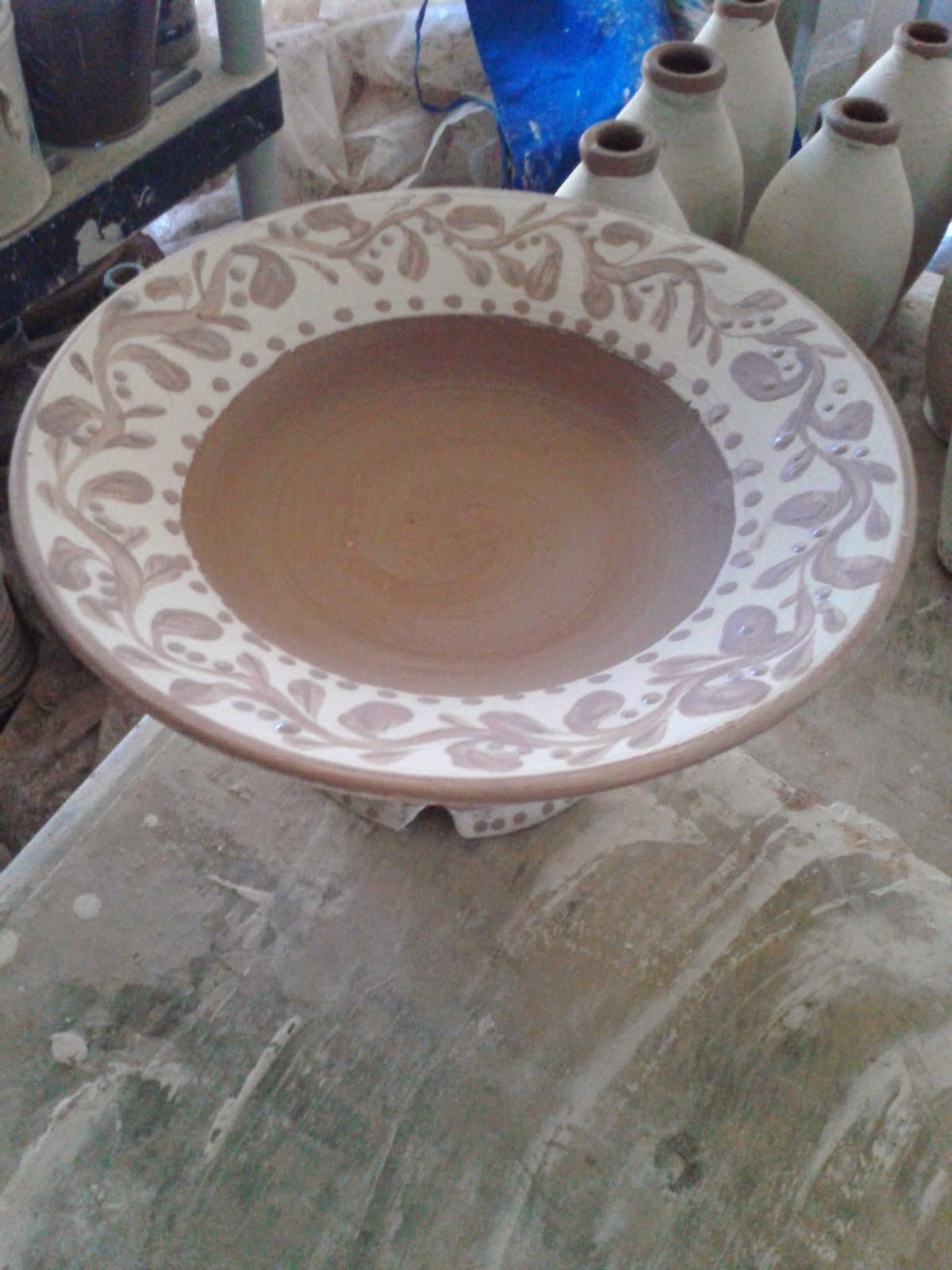
However, this form has been on my mind, and I think it was something I was edging toward in week 2 with the lobed flower dishes. I've been hesitant to make a footed dish since I fire with wood and have to prop things up to protect from the salt, but I forged forward to give it a try.
Trimmed, low dish
First I made a low, wide dish and trimmed the bottom to have rounded edges.
Foot thrown off of the slightly-dried base

Small cuts into the foot to make it have three sections
Then, I  threw a foot off of the dish. So, the dish set up for a bit until it was a little past leather hard, which allowed me to literally throw a blob of clay onto the base, pull it outward, and then raise it to make a foot. Because of the need to prop the piece up in the kiln, I cut the foot into three sections so that it could have the chance of balancing itself if it got a little wobbly in the kiln. 3's and 5's balance much better than even numbers when making cuts.

I slipped the base and rim with a white slip and decorated it all over with cobalt blue slip.

I was pleased with how they turned out in the recent kiln firing, too. The base fired fine and it seems pretty level overall.


For one dish, I cut into the base and created a pattern that pierced through the wall. I was not terribly impressed with the outcome though, and enjoy the other base much more.  
Perhaps with the slip it just did not come out as smooth as I was hoping, but I also think it detracts from the overall decoration, particularly on the rim.

Thanks to the enthusiastic response to our fundraiser we just launched! We're still working our way toward 100 bottles though, so don't miss out on the opportunity!

Monday, March 31, 2014

Kiln Firing Results and Show

 Last week was one of those nightmare weeks when everything seems to happen at once and it all becomes a big blur. We had some nasty weather again, and cleaning the pots took longer than I had hoped. Although delayed, here are some photos of pots from the recent kiln firing:


I am pleased with the results overall and very excited to see the newer forms I have been playing with coming to fruition.
All of these vessels went with me to the Catawba Valley Pottery and Antiques Festival this past weekend and some of them found new homes. Thanks to everyone who came out for the show! I am not going to fire in April so that we can work a lot on the new barn/studio at the farm.

Tuesday, October 9, 2012

Fredericksburg Kiln Site


Sherds from the Fredericksburg site. From article: http://blogs.fredericksburg.com/newsdesk/2012/10/08/19th-century-pottery-site-is-major-find/
Some very exciting news from the Fredericksburg, Virginia area! A recently discovered kiln site in Fredericksburg will have the chance to be salvaged before the site is developed. This is an important aspect, because for the kiln project I have been working on there have been too many salvaged collections where the kiln wasn't found, or part of the collection was discarded, or only half of the site was able to excavated. As I tell people, for the thousands of potters we know were operating in America's history, the likely less than 200 kiln sites that have been saved/salvaged in earthenware and stoneware should be a sign of how important these sites and collections are.(Note: there has not been a comprehensive list of all of the excavated/salvaged/explored sites in America made. It would be really fun to compile, but probably a nightmare to try and locate where they are housed! Or depressing to know that they were thrown out -trust me on that one. I have seen over 30 stoneware sites in my project and a lot of other earthenware and mixed sites along the way). You can read more about the Fredericksburg site on the Fredericksburg News Desk link. The above smattering of fragments tells me so much exciting information that I cannot wait to see what else surfaces.
Francis Bell advertisement for opening a stoneware manufactory. From article: http://blogs.fredericksburg.com/newsdesk/2012/10/08/19th-century-pottery-site-is-major-find/

One of the most interesting aspects of this small collection from the site is the bisqued handle in the lower center section of the photo.The kiln sites I have seen in Virginia have had more bisque stoneware than the other sites I have seen elsewhere. I hope to explore this more someday, but I think it comes from the fact that several of those sites were making both earthenware and stoneware, and they created a great balance of their one kiln with the production of both materials. In the spring I am thinking to fire a load of earthenware in my salt kiln just to see what happens with the salt vapors and if the temperature will stay low enough so as not to create as much off-gassing. It could have also been from a very cool spot in the kiln, but if there is a lot of bisque ware coming out of the site, I think that will be a different story.
 Let's be hopeful that those salvaging the site are given ample time to perhaps find the kiln and collect as much material as they can! And that they save EVERYTHING because the importance of the object may not be noticeable until it is being cleaned and processed.

Tuesday, March 6, 2012

Kilns Gone Wrong

Earthenware separating bars, Piercy Pottery site. Courtesy, Alexandria Archaeology Museum
There are archaeological sites where evidence of the production of stoneware and earthenware are found. Often these sites are called "transitional" with the implication that the potters were moving from working with earthenware to stoneware. However, my thoughts are that many of the potters, particularly in regions with less potters, or with higher levels of competition, met the market demands by making both either simultaneously or attempting to make both at some point in their production. For example, the William Rogers site in Yorktown, Virginia was making both stoneware and earthenware. There are certainly numerous sites where the potters did in fact move from earthenware to stoneware, such as the Thompson potters in Morgantown, West Virginia (on which topic I highly recommend an article on these potters in the 2011 Ceramics in America).
REALLY overfired bar used on the top of a jug -- the ring in the middle was the top of a jug! Piercy Pottery site. Courtesy, Alexandria Archaeology Museum

Closeup of the melted bar. Piercy Pottery site. Courtesy, Alexandria Archaeology Museum
The (nerdy) humorous thing is to see archaeological evidence that potters who may have been more familiar with one material (i.e. earthenware), may not have been familiar with the other (i.e. stoneware). Which explains why sometimes you read about potters being brought in for their expertise in one material or another. For example, when I was recently at the Alexandria Archaeology Museum, I saw a collection from the Piercy Pottery site. This was primarily an earthenware production site, but there was some evidence of stoneware production as well. I should say that there is speculation that because the amount of stoneware wasters are so low, the attempts at stoneware production were made in the late 18th-century when the site was rented by another potter who went on to make both earthenware and stoneware. Either way, the wasters revealed that at some point their stoneware attempts went horribly wrong! The stoneware separator bars they made are also some of the thickest bars I have seen yet, which is not surprising after seeing their earthenware separator bars (first photo at top). 
On left, bisque stoneware separator bar and fired salted separator bar on right. Piercy Pottery site. Courtesy, Alexandria Archaeology Museum
Their method of stacking the stoneware pottery seems more precarious, too. Typically, one wants to balance the weight of the pieces over another, placing rims, bases, and other points of weight on top of each other.
Bar adhered to base of jar, with indentation showing where the rim of another jar rested during firing. Piercy Pottery site. Courtesy, Alexandria Archaeology Museum

How the base of the jar rested above the rim of the other vessel-- off center! Piercy Pottery site. Courtesy, Alexandria Archaeology Museum
I said that this was humorous because I reflect on these pieces both as a potter and as a scholar. As a potter, I can only imagine the horror on the workers' faces when they opened the kiln and their experiment had gone horribly wrong (been there, done that!). I chuckle sometimes because I think there were a lot of "oh, poop!" moments historically, just like there are in contemporary potters' lives. And as a scholar, I reflect on the attempts of pottery production sites to challenge an import market, a growing population of potteries, and the changes in the uses of utilitarian vessels and forms.
For more information on the Piercy Pottery site, be sure to check out Barbara Magid and Bernard K. Means' article in the 2003 Ceramics in America. You can read the text here, but you miss the beautiful photos!

Monday, February 28, 2011

Preparing the Larder

I've been going through the pantry lately, playing the game of "what can I cook with what I have leftover from canning last summer" before the growing season takes off! In doing this, I've been thinking a lot about pickling and storage crocks.Making crocks also gives me the opportunity to play with my new stamps, which I am incredibly excited about. I made positives of the molds I made a few weeks ago, hoped the clay was set up just right, and went to town.
Positives of new stamps

Finally getting a small stamp with my studio name on the bottom of my pieces!

Trying out just the last name since I've been stamping just the first name for a long time
It's taking some getting used to in order to make sure the lettering is on level and in the middle, but I keep reminding myself of the many pieces I've seen stamped with letters and names that are backward, upside down, or misspelled!


I like how the handles look, and I enjoyed the opportunity to decorate with cobalt again. Spending time with all of the pieces at the Ackland exhibition gave me some inspiration for designs. The crocks that are pictured are to hold roughly two gallons, and were made with about fifteen pounds of clay each. Since making these I have made some one gallon crocks, and hope to make some smaller 1/2 gallons as well.
I'll be curious to see how the painted cobalt withstands a wood/salt atmosphere. I think I might try to fill a slip bottle and decorate that way

Handles are such a good place for running and placing glass!

I'll never claim to be a painter, but I think I can do plants and flowers decently

This is one of those instances where I had done a rough drawing of the cobalt design, and then it evolved as I made it

Tuesday, January 18, 2011

Winter Messages

I've been making some dishes similar to the piece below:
Wood-fired stoneware dish. I like the broad rim and the slightly dipped-in interior.

I also really enjoy how this shape has a bowled interior, but a straight exterior edge. I've also started rolling the rim, making it a little thicker than what is in the photo.

 I've been thinking about the potter Lester Breininger lately(I've linked an article by he and Greg Kramer since he doesn't have a website. A photo of him can be found here). Lester is a renowned potter and scholar who specializes in traditional Pennsylvania German red earthenware. He has very infamous  "porch sales" at his rather large and rambling home in Robesonia, Pennsylvania where people come from all over to see and buy his pottery. I picked up a few pieces about a year or so ago, and found that most of his dishes/plates have little messages or notes on the back. They're notes like, "it rained today" or, "It was sunny." 

Dish made by Lester Breininger Pottery.

The back of the dish reads, "Breininger Pottery/Robesonia, Pa./March 11, 2009/cloudy skies"
 I was told once about a "dirt dish" someone has that on the back was written something along the lines of "I made this for ---- who lives down the road and past the tree" which I also thought was kind of nice. So I decided to start writing some observations on my dishes. Here are my first few messages (sorry they're a little hard to read, I had just scratched them in and had not cleaned them up yet):

"Started to warm up today and the sun came out." Full date.

"Ice and some snow remains in the shade." I think I might just go with month and year.
I guess someday when the waster pile at my pottery studio is excavated hundreds of years from now (hahaha) people will have to piece together my funny messages. Remember potters, ceramics do not break down, so everything you make is likely to get dug up somewhere! Frightening thought isn't it? It makes me self conscious about the first pots I made...