Tuesday, May 12, 2015

On the Farm, New Pots, and Motherhood

The farm is in full gear as the weather has heated up and our CSA (Community Supported Agriculture) is into its fourth week.
 Mike is working on developing beds for permaculture which will enrich the soil with perennial vegetables, fruits, trees, and bushes, and help retain water on the farm.


 We split two of our beehives recently and now have 5 hives if all goes well. We are really hoping that for the farm open house in June we will be able to harvest some honey to sell again this year!
Joseph, Matthew Kelly, and Curry at the front of the kiln.

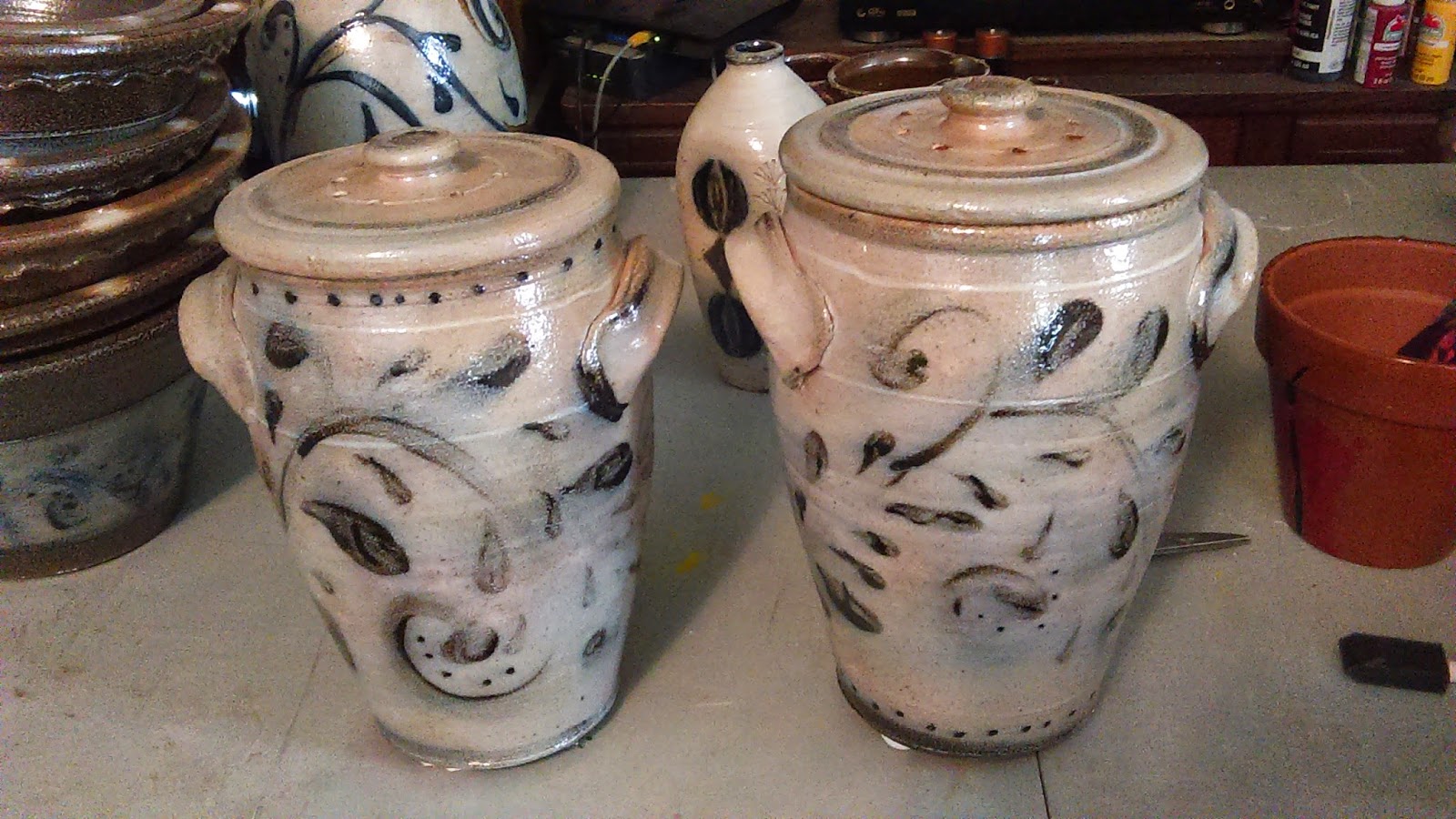
 Joseph's kiln firing went well and he had a great pottery sale with some beautiful pots. I was pleased with the work I put into the earlier part of this year getting things made and into Joseph's kiln. Here are some new pots for the spring:

Mugs

Vases


Compost Crocks


Wine cups
 I was reflecting this past weekend as I celebrated my first Mother's Day (Hallmark holiday, I know, but it was still sweet), and realized I have a lot of pots in stock and my little person is growing VERY quickly. There's a saying that the first three months of child's life is sometimes called "the fourth trimester" and I believe it. There's still a lot of soothing, cuddling, bouncing, some fussing, and a lot of development for your arms and back with lifting (he's sleeping well though, I promise!). We've just passed the three month mark, but much of my days seems to be spent like this:

Don't get me wrong, I love it! However, it does make you step back and assess things. So, I am going to not push myself to work like a crazy person and fire my kiln in June, but rather get a few things done and in a few other kiln firings with other potters, help to get projects on the farm going/done, and watch my son change daily in front of my eyes! He and I both will be at the Pottery Fair on the Square this weekend at Old Salem, we will have our June open house and pottery sale, and he is at the Greensboro Farmer's Curb Market most Saturdays, so come visit!

Friday, April 17, 2015

Clean Tools

Clean tools
I keep thinking, "where have the past several months gone?", and then I remember that I have a small person in my life! Maybe shooting for a post once each month is a good goal for now! Time does seem to be flying by. I have had better chances at uploading photos to Facebook, so if you want more frequent cute photos of Mattias, and updates on work, be sure to keep your eyes out there.
 My weeks have been largely measured by how old my little man is and how big he has been getting! However, he has also given me the chance to clean my tools, get in the studio, and start making some pots.
Sometime in February I got back in the studio and started making pots. Luckily, my little man did not mind sitting and either sleeping or watching me work around the studio.

 I focused most of my energy on getting a few gaps in my inventory filled and fluffed up for the Pottery Fair on the Square show at Old Salem in May.

Decorated mugs
 Making a lot of pots meant that it took me several days (plus several extra days of wrangling a child) to decorate all of those pots.
Mattias overseeing me making wadding for Joseph's kiln firing

Me spotting large pots being placed in the kiln
I was hoping to fire my own kiln, but have decided to push it back to June. So my pots went into Joseph Sand's big monster kiln. I have been on a few adventures lately and have gotten a few fun new historic pottery acquisitions, so I will try to do some more blog posts in the not-so-distant future! Stay tuned for photos from the kiln firing, too!


Friday, February 27, 2015

Small Potential Potter's Hands


 Needless to say, the last four weeks have been quiet here on the blog! I had my baby on January 30th! Mattias (Muh-tie-us) George was born at 5:13 a.m. and has been growing like a weed! He has fairly long fingers, so maybe he has potential as a potter, or a great fiddler!
He also has big arms, so again, maybe potter potential, or perhaps a burly blacksmith.
We are all doing well and have been enjoying the snuggle time while it has been cold and occasionally snowy outside.
I didn't think I could find something I enjoy more than working at a museum and making pottery, but I have. It's being a mom! Expect to see Mattias at pottery shows, at the farmer's market, and our farm open houses this year- so come visit and take in the cuteness! I'm hoping to be back in the studio soon and firing the kiln in April. Stay tuned!

Tuesday, January 27, 2015

Influences

The gigantic watermelon baby bump.
  Okay, so the last couple of weeks have completely blown by and I can tell you that they have been deeply entrenched in the new experience of baby getting ready to make its debut! New discomforts, lots of nesting, napping, and a little time to think about pottery here and there. I never thought I would slow down, but baby has made me do so, which has been a good thing.
Pitcher made while at Berea
Recently, someone challenged me to the Facebook venture of #3potsadayfor5 where
This got me thinking a lot about the influences I have had on my work and the various approaches I have taken in the last 10+ years I have been working in clay.

Mug made while at Berea
The most influential experience I have had thus far was the four years I worked as an apprentice production potter in the Ceramics Apprenticeship Program at Berea College. I know of no other program quite like the CAP and am grateful I had the opportunity to participate in it. Above are a few pots I made while at Berea.
Walter Hyleck pottery

Walter Hyleck pottery
 The head of the program for most of the time I was there was Walter Hyleck. He started the program in 1970 and for me was a great mentor and professor. I greatly appreciated his critiques, his honesty, and being able to watch his own work process in the studio.
Walter Hyleck mug

 On an Art Department field trip to Washington, D.C. Walter Hyleck took us on a trip to see the Baltimore Clayworks in Maryland where his son, Matthew Hyleck worked. I really appreciated that field trip and returned to Baltimore Clayworks to take a wood-firing course with Jim Dugan in the spring of 2010.
 I mostly worked with Philip Wiggs who was the resident potter for several of the years I was there. I only briefly had the pleasure of working with Tina Gebhart, and for the time I got to spend with her, I so appreciated the engaging conversations we had about the technical and chemical aspects of firing, making, and clay.
Jodie Hagenberger mug

Carla Brunsell mug

Katherine Smither- check out her Etsy Shop!
 Perhaps one of the best aspects of the program was working with a variety of other people from different backgrounds and with different creative eyes. Not everyone in the Ceramics Apprenticeship Program were Art majors (myself included), so it was fascinating to see how everyone approached their work. We were also able to make our own forms and try out different glaze techniques. So, when we started, we started with mugs. We made several designs, and then had critiques. I thoroughly appreciated the critiques and it really helped develop stronger forms. No one had to make a particular style of mug, and the forms we made could be uniquely ours, but still functional, marketable, and aesthetically pleasing. I tell people when they ask me how to make a better mug that they should make 50 or 100 of them because I am a full believer in being able to make more than one of an item first before you push its boundaries and explore different techniques- consistency is key.

Handled jar based on an historic design, made at Berea.

Berea College was also where I started dabbling in making historic reproductions. Walter Hyleck once told me that he would not bail me out of Federal Prison if I went on to make things that were exact reproductions and warned that I would have to find a way to make the pieces slightly different or well-marked if I ever pursued it seriously. You may chuckle, but it is a Federal offense and there have been people jailed for it! Some day I would like to get back to doing some reproductions.

Now, back to nesting and napping. 

Monday, January 5, 2015

Don Carpentier Tribute- the Half Saggars

Don showing the engine lathe in his pottery shop.
The world lost a giant in 2014 when Don Carpentier passed away. Don Carpentier was the mastermind behind Eastfield Village, and a maker of reproduction English mocha/dipped wares and shell-edge pottery. Eastfield was host to a series of workshops each year, focusing on various aspects of historic craft and architectural preservation. One of the workshops was focused on ceramics and pottery production, and was fondly nicknamed "Dish Camp." As a plug, the ceramics workshop as well as many of the other workshops are slated to take place this year. I will post more information when it becomes available.

Demonstrating kiln furniture and stacking at Eastfield in 2014.
I first attended the ceramics workshop in 2009, and first presented in 2011. Don was one of the few potters and skilled craftspeople that I have found such a strong connection with because of his interest in historic pottery, his experience in making reproductions, and his intense passion for learning. There are also few people I have met who get quite as excited about kiln furniture as I do. I think I was most heartbroken when Don passed because I lost such a kindred spirit and a mentor.
 Don had ALS for the last several years of his life and for the past two years that I saw him we communicated through various aspects other than speech. We once had a whole conversation in the dirt, drawing out ideas and wiping them away. In the summer of 2014 he had an Ipad that he typed things onto, but he still communicated on paper. I enjoyed our paper communications since we could banter back and forth through pictures, words, or just plain understanding what the other person was trying to say because we understood pottery on a similar level. Above is a photo of a conversation we had about half-saggars, excavated from a waster dump associated with the Bissett family of potters from New Jersey.
Photo of kiln furniture Don excavated in New Jersey. Courtesy, Don's Facebook page.

Photo of kiln furniture Don excavated in New Jersey. Courtesy, Don's Facebook page.
Don realized a few years ago through genealogical research that he descended from several prominent family of potters from New Jersey- the Bissett's and the Price's. Their exact history was obscured for so long because focus had been paid largely on the Morgan and Van Wickle potteries in New Jersey. However, Don being his lovely exploratory self, sought out more information about his family and began to break down some of the previous research on New Jersey stoneware. Above are a few photos of kiln furniture from a house site associated with the Bissett family near where the pottery operated. Don also wrote a great article on his research in the Maine Antique Digest in 2013, but the link is currently blocked unless you are a subscriber. If I get a direct link I will be sure to change it. You can read some notes on his research and collecting in a great tribute written by Brandt Zipp from Crocker Farm.


So, back to those half-saggars."Half-saggars?!" you might say? Don't worry, I said the same thing! They are purposefully-made, not fully round pieces in the same shape as a regular saggar. The edges are mostly clean-cut, and salted, so they were definitely used in the manner in which they were made.
Kiln furniture bar with piece of saggar attached.

Imprint of adjoining rim on base of kiln furniture.
Above is a piece of kiln furniture that had a piece of a saggar left on it as well as the imprint of an adjoining saggar rim.  Don came up to me while I was photographing the kiln furniture after most everyone left on Sunday. He saw me puzzling out the pieces and began placing them together so that I could wrap my brain around how they worked.
Placing a few half-saggars and kiln furniture together.


 I have never seen anything like this before or since, and am glad I took the time to measure the half saggars while I was there last summer. Saggars, as I have so frequently thought of them, are often fully round, and often enclosed (no holes or perforations) if not being used in a salt-glaze atmosphere.

Rough sketch of how the half-saggars and large bars may have interacted.
Saggars also tend to have a bottom of some kind, but instead, these saggars made use of thick, long bars that crossed the saggars to make a slotted floor.  It makes sense that this type of saggar would make use of more room and leave less empty space. Don wrote on our note I included above that they (the potters) were "desperate people," but perhaps they were just good engineers and figured something out that others had not. He also wrote "It must have been a site[sight] to see!" and truly, it probably was quite a sight when they had the kiln stacked up. As I was leaving "Dish Camp" last year, Don tapped me on the shoulder and guided me to a box of kiln furniture from the Bissett site and told me to take it home for my kiln furniture teaching collection.  I have a few small sections of these half-saggars in my collection now with the gift from Don, and hope that the other materials will stay together with his NJ pottery collection as a teaching tool. I wish I could have gone with him on his last expedition to excavate materials from near the pottery site in New Jersey.


Also, the week of "Dish Camp" was the beginning of when we started telling people I was pregnant. I will never forget the gleam of joy on Don's face when I told him. After giving him a hug before I left Eastfield, I told him to take care. He looked at me, smiling, pointed to my stomach, and mouthed, "you take care, too!"Thanks for all you did, Don, and for the short years I got to know you.