Some exciting things at the farm include the fact that the sun is shining, it's trying to dry out, the weather is getting warmer, and there are GIRDERS going on the piers for the barn!
The boards are getting laminated together and then screwed in and nailed.
Equal in excitement is the fact that the spinach direct seeded into our new greenhouse is coming up!
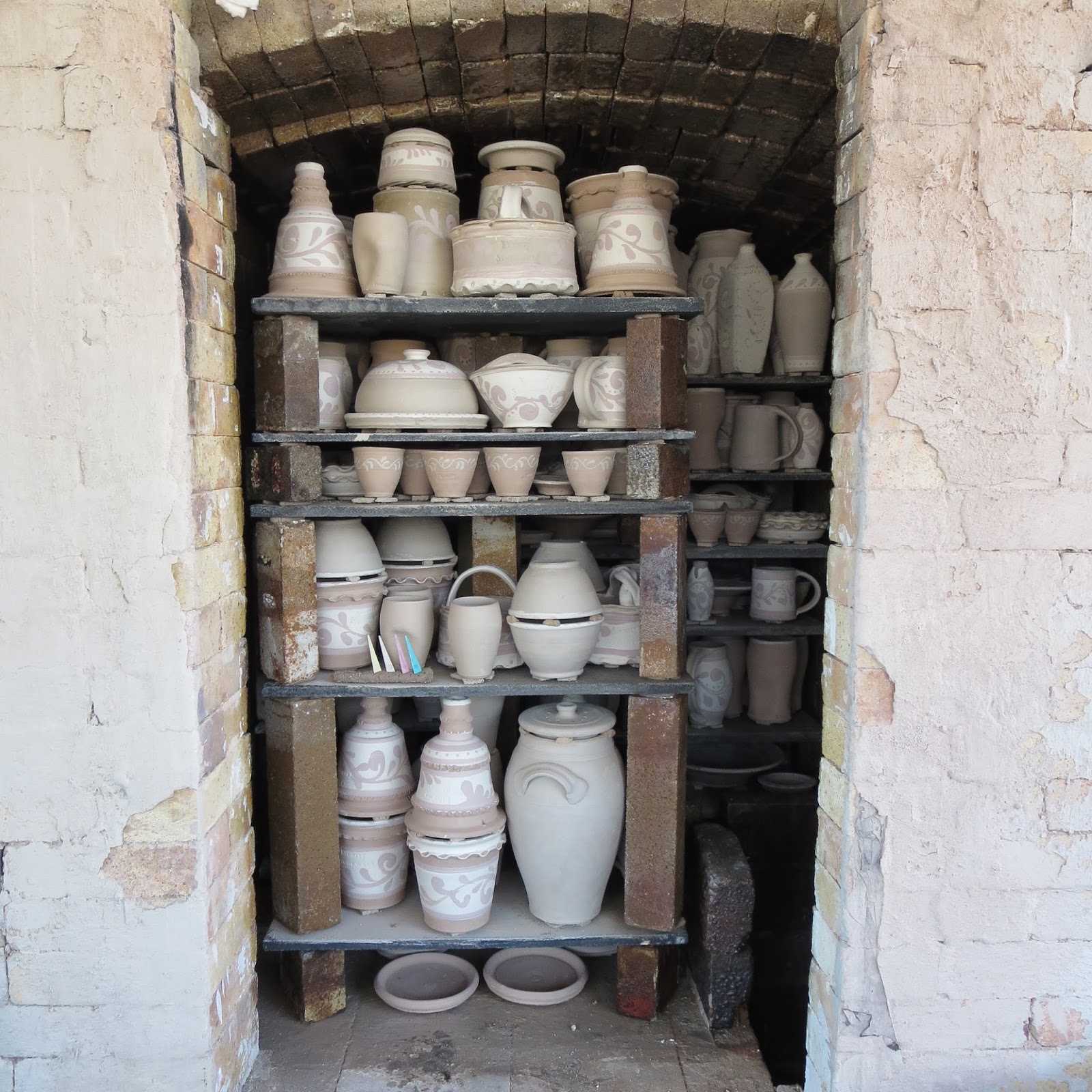
After the ice set back on Tuesday, I got back in the kiln on Tuesday afternoon and Wednesday and got it halfway loaded.
It was pretty cold at the farm when these photos were taken on Wednesday. The hard brick in the kiln retain the cold temperature and it feels like loading pots in a frozen tomb!
Above is a photo of the kiln all loaded up. I've got it pretty stuffed, but hope it won't make for a difficult firing.
Then I bricked up the door, making one flat wall on the front.
Finally, I mudded up the door with a mix of refractory clay and sand. I once again forgot to leave a brick free to check the cones in the front. This seems to be my repeat "oops" moment.
Mark your calendars, we have set a date for the farm open house and pottery sale at the farm in June! Sunday, June 15th from 11:00 a.m. - 5:00 p.m.
Friday, March 21, 2014
Tuesday, March 18, 2014
Curse and a Blessing
Yesterday I thought I was on top of things. I had a work meeting in the morning and then was just going to finish up a few planter dishes to tuck under the shelves in the kiln. Then it dawned on me that I had not made garlic dishes. It is a blessing that I single fire the ware in my kiln. This means that I do not bisque fire the pots before they go into the final firing. It makes for a little slower firing overall, but I enjoy the process. It also allows me to sometimes make these last minute items that have slipped my mind. It is a curse because I don't hold myself to extremely strict deadlines of when I can and cannot be working on wet work to put in the kiln. I seem to keep pushing it every so often, and though I have not regretted it yet (knock on wood), I'm waiting for the day I learn a lesson about when something is not quite dry enough for a single firing.
![]() |
| Ice on grass |
![]() |
| Ice on the rose bush |
I made it to the farm this afternoon and started loading the kiln. The Catawba Valley Pottery and Antiques Festival is the 28th and 29th!
Saturday, March 15, 2014
52 Form Project - Weeks 9 and 10
The 52 Form Project
What is it?
My 52 Form Project is devised to help me stretch my creative muscles,
explore new forms, or finally get to making forms I have been wanting to
try for a long time. I am planning to make a new or modified form for
every week of this year.
How can you help?
Your input on the forms, their shape, decoration, appeal, and function
would be greatly appreciated. Some forms, if they seem like they may do
well in the market, may become a part of my regular production.
Week 9 and 10
As a part of the 52 Form Project, I wanted to revisit a form I made several years ago. The lidded dish I often called a "butter dish" until I was repeatedly asked if it were possible to use it for other purposes. They are made of two pieces, a low dish and a rounded lid.
I am excited to see what these dishes will look like in the kiln firing. I made sure to glaze the interior of the lid. The first time I made this form I found that the interior of the lid stayed very dry, which I think could be seen as disconcerting.
I also made an attempt at a lidded dish with two flattened sides. I cut the base much like the way in which I made the baskets, but rather than cutting one feather shape in the base, I cut two on either side of the dish base.
![]() |
| Courtesy, Arizona Daily Star |
![]() |
| Courtesy, Invaluable.com |
Rose Cabat makes what she calls "feelies" which are seen in the photo above. I don't tend to be attracted to a form like this, but I think through my interest in her life and work as a potter I am fascinated by the form, the name, and the glazes.
When I went into making the form though, I found myself reverting to the familiar ovoid shape. I made a few pieces that admittedly look basically like ovoid bottles without handles, but then I went toward a different shape.
I have a terrible time leaving enough clay at the shoulder and neck for making a small bottle neck or opening. Because of this, I found myself with an ovoid shape (which I love) and a simple, cupped rim. I think it might have some potential as a decorative vase, but I will reserve my final judgement for after the kiln firing. Here is how the other decorated pieces ended up:
![]() |
| White slipped surface with a scratched design |
I am going to work a little more on this venture. Making the ovoid shapes with the open rim (as opposed to the bottle shapes) felt really good and the design feels like something I want to return to. The bottle shapes felt just like that, bottles. If they had not dried out so quickly with the power outage, I think I would have just put handles on them, because they just look like bottles to me. Maybe I will also go back to attempting some "feelies!"
Friday, March 14, 2014
Improvisation
![]() |
| Improvised wheel set up |
I was okay with using a substitute wheel until the other day. I weighed out my clay to make wine cups and pint cups, and when I turned to the wheel, I thought, "oh, no." Not one of those quick, surprised, "oh, no's," but rather a drawn out, deep-voiced, dramatic, "ohhhhhhhh.....nnnoooooooo!"
Why did I have this thought? It hadn't occurred to me just how accustomed I had become to my little Creative Industries wheel, until I realized that I based the heights of my cups on items sitting on the table that surrounds the wheel. So, basically, I put a long paint brush off the end of my water bucket to gauge my wine cups, and something similarly with the pint cups. It took some figuring and ransacking the broken pottery collection to find the right combination of things to get the correct heights. Above is what I came up with. Never a dull moment!
Thursday, March 13, 2014
Earthenware Kiln Furniture
In taking down the exhibition at the North Carolina Pottery Center, I had a few moments to handle and ponder over the earthenware kiln furniture that was on display. As esoteric as kiln furniture may be, it is an incredible insight into pottery production. When I look at kiln furniture, I don't just get excited about the individual fingerprints that usually cover the surface, I see in my mind how the pots were stacked in the kiln using each piece. That may sound a little weird, but that is how my brain works- see a piece of kiln furniture, see a stack of pots. Or else you can watch my eyes shift around as I study the kiln furniture while I am trying to stack the pots in my brain.
These particular pieces come from the William Dennis site in Randolph County, North Carolina. This also happens to be the same site where Hal Pugh and Eleanor Minnock Pugh have their pottery shop, New Salem Pottery. Drawing from their text panel in the exhibition, here is a little background on the Dennis potters:
Located in North
Central Randolph County, NC, the property was settled in 1766 by the Thomas
Dennis Family who along with other Quakers had relocated from Chester County,
Pennsylvania. The property sat astride the Trading Road (formerly the
Indian Trading Path) which extended from Petersburg Virginia into South
Carolina. The location and the existence of large beds of earthenware clay made
it ideally suited for a pottery. William Dennis (b.1769) and his son Thomas
(b.1791) were the earliest documented potters working at the property. William, a Quaker opposed to slavery, apprenticed
George Newby, a 12- year old African-American youth, to learn the pottery trade
in 1813 which lasted nine years until 1822.
Archaeological evidence and extant collections reveal that the Dennis
potters not only made simple, utilitarian lead-glazed earthenware, but also a
variety of decorative slipwares and thinly turned tablewares. William
moved to Indiana in 1832, selling the land where the house and pottery stood to
Peter Dicks, a Quaker businessman and potter who lived in the nearby community
of New Salem.
The site was discovered in 1974 by Hal and
Eleanor after plowing a garden spot. After several years of research the site
was identified as belonging to the potter, William Dennis. In November of 1997 Tom Hargrove of Archaeological
Research Consultants, Inc. conducted non-evasive geophysical surveys at the
William Dennis site to determine its subsurface integrity. A very distinct
classic kiln signature was shown to exist and a decision was made to focus on a
test excavation at the kiln site. Fieldwork began in March 1998 and excavations
were done by Dr. Linda Carnes-McNaughton and volunteers. Units confirmed the
anomaly or feature at the Dennis kiln site was the foot print of a 10 by 10
foot square kiln constructed with two foot thick fieldstone walls and lined
with brick. This square design, which is
the first excavated in North Carolina, appears to be of Quaker tradition. Two later examples of this style of kiln have
been found in NC at Quaker pottery sites.Earthenware kiln sites, particularly early, have the closest thing to a contemporary kiln shelf used in the firing. Predominantly, large, flat pieces of clay do not show up in stoneware kiln sites, and show up in incredible numbers in earthenware sites. I think this has more to do with the fact that salt adheres better to large, flat surfaces, so having fewer contact points provided for a better firing. Some stoneware sites I have looked at do have a few of these slabs of clay, but nowhere in the numbers as they show up at earthenware sites.
These pieces in earthenware kilns, though, are not as large as contemporary shelves. They tend to be made in much the same way that roof tiles are made (slabbed out, certain thickness, certain width, and texture on one side). They end up being longer than they are wide. They also sometimes have grooves on one side (like roof tiles), made either with fingers raked across the surface or a tool. This provided for less contact points too, because even though salt was not used, the glazes sometimes ran, and some pots were fully glazed (meaning the exterior of the foot was glazed). In Bethlehem, Pennsylvania, the Moravians there were literally using roof tiles, with the cut out holes, or tabs for hanging the tiles, still on the piece, but clearly stuck in the kiln between a few pots. That example may also reveal how roof tiles were fired.
| Rim on the kiln furniture |
| Rim on the kiln furniture (same piece as above) |
Then you also have examples where two tiles are stuck together. It's moments like these when contemporary potters can be empathetic for historical potters. Think of when a glaze has totally run off on you, destroyed a shelf, or destroyed another pot.
In other notes, I am back in the shop this week, rampantly working to get pots finished for loading the kiln next week!
For more information on the Dennis site and the excavated material, see the 2010 Ceramics in America publication with an article entitled "The Quaker Ceramic Tradition in Piedmont North Carolina" by Hal and Eleanor. As an exciting note to end on, this year the William Dennis site was approved for the National Register of Historic Places.
Tuesday, March 11, 2014
Flexibility
Life has a good way of teaching you to be flexible. After a broken wheel the other week, we were hit with an awful ice storm last week. Pottery and farming have been pretty good at teaching me to go with the flow.
This storm shut off our power for several days and wreaked havoc all over the area. Above is how we cooked supper one evening. How romantic, right? As one of my friends said to me, "I worry about you less than just about anyone I know." I guess working at living history museums and reenacting has its perks to prepare you for going with the flow when the electric goes out!
| Weighted down tree in the front yard |
Production was put on hold for the days without electricity, but I was able to make it out of the house to help out at the North Carolina Potter's Conference. It was great to be among a laid-back crowd that was flexible enough to deal with power outages and changing program schedules. I'll post more about the Potter's Conference soon.
I got back in the studio on Sunday to get things glazed and decorated.
![]() |
| Empty cases at the Pottery Center |
On Monday, I dismantled the "Old Ways in Mind" exhibition at the North Carolina Pottery Center.I was elated to take it down, but happy to have seen it on Sunday with other potters at the Center.
Today I was in the studio for my last week of wet work. I call it my "last week of wet work" since that was what we called it at Berea College when I was in the ceramics studio there. Do you all have terms for your last week before the cut-off date to have pots ready for firing?
Wednesday, March 5, 2014
On the Farm and the Wheel Debacle
Well, late last week (Thursday and then into Friday morning), my trusty wheel motor died. If any of you fine readers happen to have a Creative Industries Model MP (earlier model, probably not 1 HP) wheel and could tell me some specs on the motor, that would be awesome. I'm hoping it is just the bearings, and have ordered some replacements, but the labels on the motor were removed at some point so I do not know the RPM, horse power, or voltage. If I don't have the specs just right, I can blow the controller! I'm limping along with an older Shimpo that also has a motor going out, but the photo above is where Week 9 of the 52 Form project got stopped! I've been playing a lot of catch up this week, so week 9 & 10 may just have to get combined when I can get things back in order!
Other projects this week in the studio have been mostly small items easily thrown on my rickety wheel. Bowls, mugs, and bottles have been filling the tables and shelves up!
![]() |
| New basket shapes |
![]() |
| Pouring soil into the beds |
![]() |
| Beds filled! |
![]() |
| Plastic on! |
In other news, we have plastic on the greenhouse and soil in the beds! I personally raked and hoed about 24 cubic yards of soil into the beds! The greenhouse plastic went on this past Sunday just before we had some snow and ice on Monday.
This morning's adventure was to pick up some wood for future kiln firings. This weekend is the North Carolina Potter's Conference. I'll be there on Friday and Sunday, and think it should be a good time.
Subscribe to:
Posts (Atom)