Tuesday, January 28, 2014

State of the Artist Address

 On the day of the State of the Union Address, I am thinking about the state of my art for a statement that describes my work and the path it is scurrying along. We'll not go into the discussion of whether my work is art, craft, or neither and that I am not an artist but a maker. That can be saved for another time. I never pursued an official degree in the Arts(which I sometimes regret), and never really wrote an official artist's statement. A few paragraphs here and there, some lines on a post card, but not a full blown statement. It is that time of year though that applications are being filled out for various things, and some places ask for an artist's statement. Dan Finnegan was grappling with this recently too, and I commented that I always feel like my words come across as textbook-like and that I liked how he was relaying his work and passion.

To each his own, I know, and that every person's statement may be vastly different from one another. There are thousands of web pages and content for learning how to write an artist's statement, and it all depends on the media and the way you are relaying the information to the public.  I enjoyed this article on "Explaining the Unexplainable" in writing an artist's statement as an introduction to your work with clear language and not bogging down your readers. It reminds readers to remember that people have short attention spans, and that less is more should entice them to ask more questions, not run away (or worse, lose interest).

As I have watched my work over the last year really come together in a more cohesive way (as I think you can see in the share of photos from my work last fall), I find myself wanting to portray what it is that makes my work more cohesive now than it ever has been. My first full year of having a wood-firing kiln all to my own to play with I think really brought out a lot of strengths in my work and I am excited to share that with a broader audience.

I went for somewhat casual and conversational, but really tried to answer the questions that I get asked the most. It helped to think about my statement in that way- what do people ask about the most, what questions can I answer on paper if I cannot speak to them one at a time?

Here is what I am toying with, and input would be greatly appreciated:
______________________________________________________________________


My passions for pottery and history meld on the pottery wheel. My work is heavily influenced by my studies of historic ceramics and kilns, archaeology, and a background of working in museums. I enjoy the aesthetic of historic American pottery, the graceful lines, strong forms, and the fluid cobalt blue decorations on salt-glazed stoneware. Some of my favorite pieces of historic pottery are basic, utilitarian pots for the beauty of their function and plain artistry.


I have been making pottery for nearly ten years and began my pottery business in 2010. In 2011, I became co-owner of a farm, Emmaus Farm, which finally gave me the chance to have a place to put down some clay roots. In the summer of 2012, I built a wood firing kiln on the farm. Using this wood firing kiln, I primarily use a method of single firing, which avoids bisque firing and involves glazing pottery when still damp and firing the pottery raw. The decision to use this traditional method has given me the chance to experiment with glazes made from local clay, ash glazes, and natural clay glazes. My pottery is made with North Carolina stoneware clay and is salt glazed. This means that at around 2,300 degrees Fahrenheit I literally put table salt in the kiln which vaporizes and adheres to the pottery, making a glassy surface.


I focus on utilitarian pottery forms to bring pleasures and delights for daily use. Other than slip decoration, I allow the natural color of the clay body and the flashing from the flames to grace the surface of my pots and provide a palette of appealing earth tones. The farm inspires me to make compost crocks, pickling crocks, and fermenting jars as an extension of my interest in lactic fermentation, pickling, traditional cooking, and living a sustainable lifestyle. 

______________________________________________________________________ 

There are a few places where I question what I am up to, or what I am trying to get across. I am naturally a little wordy (if you have not figured that out from my writing yet) and often have a hard time cutting things down. For instance, I don't want people to think all of my cobalt designs come from New England, because a majority of them don't. However, I don't know whether to say the following and be called out for playing with a New York flower (because they do have some pretty flowers on their pots:

"My work is heavily influenced by my studies of historic ceramics and includes painting cobalt blue decorations based primarily on Southern American stoneware."

Or is including archaeology, historic ceramics, etc. too hoitey toitey or high falutin'? I worry that using the words "plain artistry" implies a word that I detest when applied to historic American pottery - "primitive"- because none of it was "primitive" if you ask me, and I do not want it to read like that.

Any input would be greatly appreciated. I hope you all are staying warm. The White Death (snow) is not upon us, and we shall see what comes! 
 

Monday, January 27, 2014

52 Form Project- Week 4

Scene from the Sketchbook
The 52 Form Project 
What is it?
My 52 Form Project is devised to help me stretch my creative muscles, explore new forms, or finally get to making forms I have been wanting to try for a long time. I am planning to make a new or modified form for every week of this year
How can you help?
Your input on the forms, their shape, decoration, appeal, and function would be greatly appreciated. Some forms, if they seem like they may do well in the market, may become a part of my regular production.
Week 4
Anna Pottery Hanging Planter, Courtesy, Crocker Farm
When I first came across this hanging planter made in the 19th-century at the Anna Pottery in Illinois, I was captivated. The shape, the function, and the design just had me mesmerized and I knew I had to make a hanging planter with those same concepts some day.

I made the bodies of the planters and used a tool to coggle the edges and rim to make a decorative surface.
Underside of the hanging planter. Courtesy, Crocker Farm
The base had me perplexed for a little while, trying to figure out how they made the piece. I initially thought they threw it as you see it in the photo above, but when I saw how smooth the interior was and paid more attention to the rim and the other components, I figured out that they probably trimmed the piece and then threw another piece off of the base to make the conical opening.
Conical opening thrown off of the base after trimming

Upside down hanging planter
I gave that a try and liked the results. I added white slip in order to paint some blue cobalt decorations on them before the firing, and stamped the pieces with "Liberty Stoneware."
Above is the right side-up view. I have a few kinks to work out (like the mistake I made of putting four holes instead of three on the rim- workable, but more time), but I'm excited to see how they turn out in the kiln. I'm devising how to fire them, and may implement some creative stacking!
I've made 2 pound smaller ones (pictured above), some 4 pound ones, and 6 pound ones. This has been a really fun form to play with and if they turn out well, may be something to stick around!


Saturday, January 25, 2014

A Lesson in Kiln Furniture

As a part of the exhibition I curated at the North Carolina Pottery Center (on display through March 2014) I included a section looking at kilns, kiln furniture, and how kilns were fired and stacked historically.
Layout for a cross-draft kiln, not using as much stacking because of the height of the arch on the kiln
For the cross-draft kiln display I showed how pots were placed on quartz or other kinds of floor coverings, and then generally not stacked (sometimes they are) but able to stand from tallest to shortest depending on the height of the arch on the kiln. So the pots end up standing next to one another rather than stacked on top of one another.
Chester Webster jugs
Two vessels attributed to Chester Webster of North Carolina in the 19th-century show how in a cross-draft kiln there is usually directional ash coverage on the pieces- meaning one side is coated with more ash than another because the side facing the firebox is more likely to be hit with ash and direct flame.
Beginning of the updraft/downdraft stack
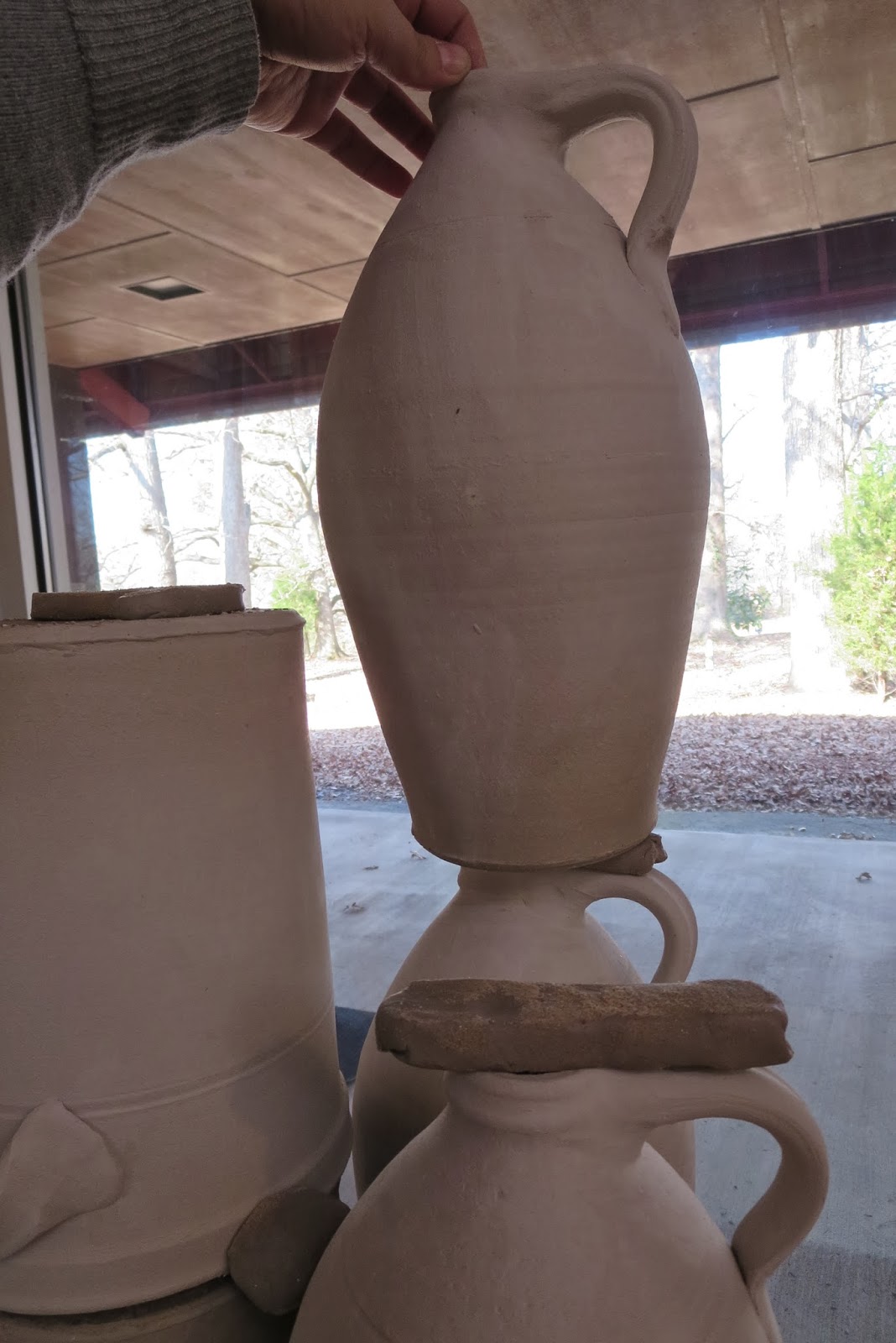
Then I went to work on the updraft or downdraft kiln style, stacking the pots on top of one another with kiln furniture. I made the pots a few days before I installed so they were moderately dry. The kiln furniture was fairly damp and I let the bars set up before installing them so they wouldn't warp or collapse. My initial thoughts on loading historic kilns were that the vessels were still green or damp when loaded, and they were placed in the kiln as they were made and able to be loaded. I've read a few things about this being done in cross-draft kilns, but don't have concrete evidence of it being done in an updraft or downdraft kiln. I am rethinking things, and here's why:

Making bars
Laying bars on the jugs
Once the bars were set up, or lightly dried, I placed them on the tops of the jugs, and underneath of the jugs and used them on the rims and base of the straight-sided crocks. This was based on pieces of pottery I saw with marks from the bars and archaeological collections where this type of stacking was used, such as the kiln site in Fayetteville, NC.


Placing spacers of different sizes

And spacers of different shapes
I placed spacers between the vessels to keep them from shifting onto one another. I sanded the ends of the pieces, and even put some glue on them since they will be there through March. I figured things were good to go- that the clay would all dry at about the same rate and that it would stay standing. Or, so I thought.
All stacked up!
At least it stayed standing. Here is what I found when I returned less than one week later:
Separated kiln furniture and one piece that kept falling off
Separated kiln furniture
The furniture was not holding up so well. It was falling off, shifted, and had completely separated from the vessels! I am glad I tried this before doing this in my own kiln, but now it is back to the drawing board for thinking out placement and installation of the spacers and other pieces. It makes me wonder whether the historic pieces also separated like this, and maybe fell down, but that the slight separation created during the drying was overcome by the shifting and movement of the pieces during the firing. I will keep you posted!

Thursday, January 23, 2014

On the Farm - Winter's Pause


Tiny sprouts of kale starting to show themselves

We are in the spell of another cold snap here in Central North Carolina. We got a bit of snow the other night (not but barely an inch), the ground has frozen up pretty well, and some of the snow has stuck around. Tonight is another cold night (which means around 10 degrees Fahrenheit for us), so we're hunkering down and trying to figure out what other things to accomplish.

It makes me think of the following poem by Wendell Berry entitled, "To Know the Dark":

                                                 To go in the dark with a light is to know the light.
                                                 To know the dark, go dark. Go without sight,
                                                 and find that the dark, too, blooms and sings,
                                                 and is traveled by dark feet and dark wings.

The screeching halt of a cold night and frigid day stops concrete work, freezes the chicken's water, and limits our ability to work the soil. There is movement in the cold though, and there is growth. We have started seeds in the greenhouse and they are emerging from their little pockets of earth. As in the photo above, we have things that are starting to bear themselves above the earth, and as exampled by our carrots from the other week, still have things that are in harvest.

Chickens frolicking in the straw
When it snows, I always find myself being contemplative (perhaps going into "the dark") because I think of the hush that a blanket of snow puts on the world (not that a blanket of snow comes to this part of NC that often). This gives me a few spare moments to watch the chickens a little closer when we give them a bed of straw for the cold night and they ravage it to no end in less than five minutes. It also gives me brief moments to step back and look at things we have achieved and projects to come.
Never ending wood splitting
Without the concrete work or the willing frozen ground to till under, we turn to cutting and splitting wood for upcoming kiln firings, and try to tend to the work that always seems endless, but we will get behind in by the middle of the year. May we "catch up" on a few projects before the warmer weather finds us again!

I'll close with one more Wendell Berry poem called "The Cold":

How exactly good it is
to know myself
in the solitude of winter,

my body containing its own
warmth, divided from all
by the cold; and to go

separate and sure
among the trees cleanly
divided, thinking of you

perfect too in your solitude
your life withdrawn into
your own keeping

-to be clear, poised
in perfect self suspension
toward you, as though frozen.

And having known fully the
goodness of that, it will be
good also to melt.

Wednesday, January 22, 2014

Scraps of Quotes


I am one of those individuals, guilty as charged, who writes things on scraps of paper and (usually) inevitably misplaces those scraps unless put on or near my desk. I was sorting through random things on a bookshelf this morning and came across the scrap in the photo above with a quote scrawled out in my quick chicken scratch. The quote is as follows:

                                                            "Behind us in our path we cast
                                                             The broken potsherds of the past
                                                             And all are ground to dust at last,
                                                             And trodden into clay!"

It comes from Flora Haines Loughead's A Keramic Study: A Chapter in the History of Half a Dozen Dinner Plates. The quote reminds me that ceramic does not break down archaeologically like other materials, so while various piles and middens in the future may fragments of my pots (or the mountain of things collecting around my kiln), eventually they may end up so broken down and lost to dust. I don't think the pots would actually be able to be clay again because of the firing temperatures, but it's kind of romantic to think about it in that way!

Tuesday, January 21, 2014

Compost Crocks


I first saw what was referred to as a "compost jar" in California over five years ago. I was mesmerized. I won't say I was impressed with the design or shape, but the idea of a ceramic version of the increasingly popular metal can that was popping up on the market was appealing. If you are not familiar with the form, they are for storing table scraps before transporting said tables scraps to the compost pile. So, not a composter, but a pleasant way to hold compost on the countertop, rather than hiding a plastic bucket under the sink (which I was once guilty of)!

The design I have for the compost crocks has come a long way since I started dabbling with them in 2010 and 2011. I really enjoy the ovoid curve they have taken on now and the wood-fired, often toasty, surface they have. Firing them in the wood kiln without any glaze on the exterior is also exciting because I never do know what they are going to look like when they come out. Sometimes they are heavily salted and really shiny, and sometimes they are lightly salted and buff. The white slip-trailed decoration comes from various patterns of historic pottery decoration and is a subtle pattern to grace the shoulder of the vessel. I am pleased to have them listed on my Etsy shop and am always excited when they find good homes!

Decorated compost crock
I have made a few decorated compost crocks with a white, porcelain slip ground and cobalt blue decorations, and intend to get a few more in the works for the coming year. 
Carbon filter under the lid

Holes for ventilation in the lid

It took me a while when I was developing them to figure out just how to get that carbon filter fitted into the lid and still be removable. The ventilated lid helps air out the compost so it does not become a liquid-ey mess, and helps keep the smell down. All compost vessels need to be emptied at least weekly. The lid and carbon filter also keeps the fruit fly population down, however, fruit flies are fairly inevitable. I recommend trying diatomaceous earth (or D-E) sprinkled in your compost crock, it keeps fruit flies from producing quite as heavily and breaks down their little pesky bodies (gross, but rewarding in the end!).
Sometimes they get a nice splash of ash and salt on one side in the wood kiln
Stoneware is a fascinating material. In historic kitchens, it was prized for its ability to hold liquids because of the vitrified state of the body, which made storing salted materials or pickled materials much easier than in earthenware. It was also prized because it was odorless, or did not absorb the contents of the vessel like earthenware was apt to do, and had a less likely chance of rancidity. This concept plays into why I make ceramic compost crocks. Unlike metal and plastic, ceramic is less likely to absorb odors, and with a glazed interior, are much easier to clean.

Breakage is sometimes a concern, but I make the rims and feet fairly thick. I'm fairly rough on my pots, and stoneware is a pretty sturdy material. Dropping it on the ground (not concrete) has been known to happen and still survive! Although, all ceramics have to be cared for in one way or another.
I'm happy to have developed a functional form that is pleasing to the eye and appealing for use in a kitchen setting. It also connects to our farm and the sustainable practices we support, such as composting. Spring is coming, consider composting!

Monday, January 20, 2014

52 Form Project- Week 3


The 52 Form Project 

What is it?
My 52 Form Project is devised to help me stretch my creative muscles, explore new forms, or finally get to making forms I have been wanting to try for a long time. I am planning to make a new or modified form for every week of this year

How can you help?
Your input on the forms, their shape, decoration, appeal, and function would be greatly appreciated. Some forms, if they seem like they may do well in the market, may become a part of my regular production.
Week 3

Bottles with a garlic dish
This past week was much better than the second week blunder, and perhaps if I get my act together I will actually post photos of the previous week at the end of that week rather than the beginning of the next! For Week 3 I made small bottles for vinegar or oil to accommodate a pouring spout.
Pouring spout sitting in the top of the bottle
 I made these to accompany the garlic dishes I started making late last year.  I have decorated them to compliment the current decoration on the rim of the garlic dish.
Faceted bottles

I returned to faceting, which is something I did for a little while and was enamored with the process. Faceting means that you cut away sections of the clay vessel with various tools. I like to use a cheese slicer!  I had never tried faceting a bottle, and while I am glad I tried it, I don't think I will continue the design.
Downfall of faceting

Of course, in faceting there are always pitfalls such as the photo above. Because you cut away the clay, if the wall of the vessel is not thick enough, you will inevitably cut through the vessel.

Bottles with indentations

I also made a few bottles with indentations on the sides, similar to how I make indentations on the wine cups. I enjoy this design the best, and think I will make a few more for the next firing. They are very comfortable and easily grasped for pouring. Now on to week 4!